
Summary of Withings GO activity tracker teardown
This article provides a teardown of the Withings GO activity and sleep tracker, analyzing its components to estimate manufacturing costs. The author unboxes the device, disassembles it using basic tools, and examines the internal hardware, including the battery specifications and waterproofing features, to understand its low-power design and build quality.
Parts used in the Withings GO:
- Round plastic casing with e-ink display
- Wristband
- Pocket clip
- Small plastic coin (opening tool)
- Panasonic 3V CR2032 battery (225mAh)
- Seal ring for waterproofing
For this first edition of the hardware teardown, we’re dissecting technology and lifestyle brand Withings’ cheapest activity and sleep tracker: the Withings GO.  Since they launched their first connected weighing scale back in 2010 (the WiFi Body Scale), I’ve been a big fan of Withings. They make beautiful products that integrate seamlessly with their online platform and that seem to have a very decent lifespan: that scale I bought in 2010 still works just fine (although I recently upgraded to the new Body Cardio to get some of the new features).
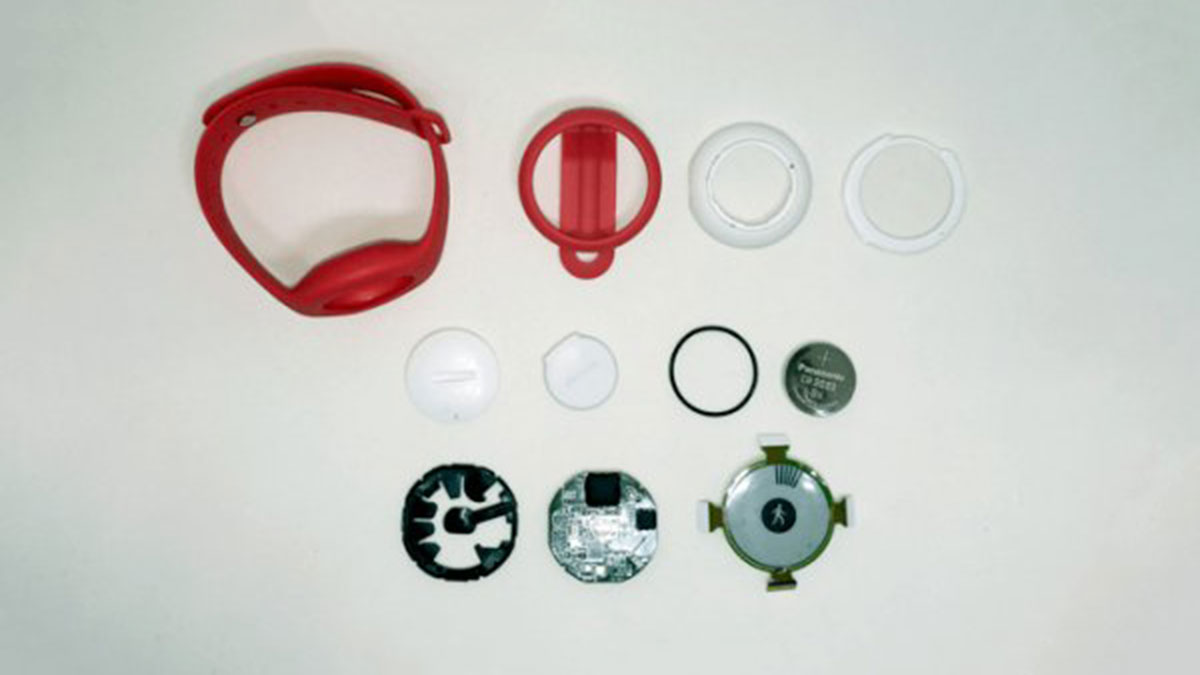
In this post, we’ll be treating their small activity tracker less kindly: we open up the casing, look at all of the main components and what they do, and try to recreate the BOM (Bill Of Material) and COGS (Cost of Goods Sold) to determine the actual cost of this tracker retailing for €69,99.
The first step: unboxing!
When you open the box, there are 4 items in it. First off, the tracker itself, with an e-ink display in a round plastic casing. Then a wristband, to wear the GO as a watch, and a clip to attach it to your pant pocket or belt. Finally, the packaging includes a small plastic coin with which you can open the back of the tracker to replace the battery.
Next up: Opening the tracker
I used only basic tools to take this tracker apart: a cutting knife, tweezers, and a USB microscope.
First, we removed the battery. This is easy: you can simply open the back of the casing with the included tool or with a regular coin. The included battery turned out to be a Panasonic 3V CR2032 with a capacity of 225mAh. In other words, it could power a device consuming 225mA for one hour. According to the Withings GO product website, the battery can last up to 8 months, so simple math tells us that the tracker consumes only 43.4 microamps. With real life usage, that number will probably turn out a little higher, but even then it’s a very low-power device.
Removing the battery also exposed a seal ring used to make the enclosure waterproof – necessary, as the Withings GO tracker is advertised as being able to detect when you are swimming.
Read more: Withings GO activity tracker teardown
-
What items are included in the Withings GO box?
The box contains the tracker, a wristband, a pocket clip, and a small plastic coin for opening the back. -
How do you open the back of the tracker to replace the battery?
You can use the included plastic coin tool or a regular coin to open the back of the casing. -
What specific battery model does the Withings GO use?
The device uses a Panasonic 3V CR2032 battery with a capacity of 225mAh. -
How long is the battery life claimed by the product website?
The product website states that the battery can last up to 8 months. -
Does the Withings GO support swimming detection?
Yes, the tracker is advertised as being able to detect when you are swimming due to its waterproof seal. -
What tools were used to take apart the tracker?
The teardown used a cutting knife, tweezers, and a USB microscope. -
What is the purpose of the seal ring found inside the device?
The seal ring is used to make the enclosure waterproof.
