
Summary of THIS IS THE FUTURE OF WASTE MANAGEMENT
The article describes "Binbot 9000," a voice-controlled robot designed to autonomously transport rubbish to recycling. Built by James Bruton, it uses an aluminium frame and Arduino Mega for motor control, supplemented by an Nvidia Jetson Nano and Raspberry Pi camera for accurate navigation via fiducial markers. The project integrates DeepGram AI for voice commands, allowing users to summon the bot to fetch items or dispose of waste, solving the manual labor of packaging disposal.
Parts used in the Binbot 9000:
- Aluminium extrusion frame
- T-nuts
- 3D printed pieces
- Off-the-shelf bin
- Rear-mounted caster wheel
- Gimson robotics 24-V worm-geared motors
- 3D-printed TPU tyres
- Big servo motor
- Arduino Mega
- BTS7960 high current H-bridge drivers
- Wheel encoders
- Nvidia Jetson Nano
- Raspberry Pi camera
- Fiducial markers
- USB Omni-directional microphone
Many of us have been asking for some time now “where are our robot servants?” We were promised this dream life of leisure and luxury, but we’re still waiting. Modern life is a very wasteful one, with items delivered to our doors with the click of a mouse, but the disposal of the packaging is still a manual affair. Wouldn’t it be great to be able to summon a robot to take the rubbish to the recycling, ideally have it fetch a beer at the same time? [James Bruton] shares this dream, and with his extensive robotics skillset, came up with the perfect solution; behold the Binbot 9000. (Video, embedded below the break)
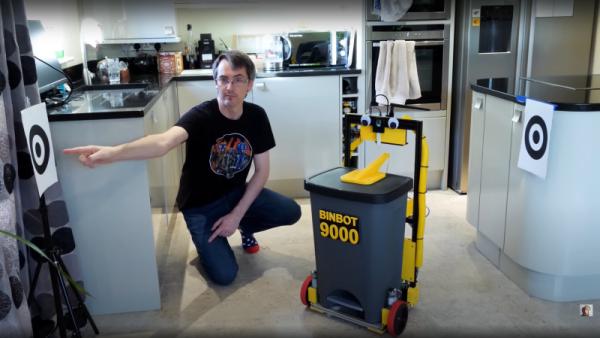
With a frame built from aluminium extrusion, using t-nuts to attach to 3D printed pieces where required, the off-the-shelf bin fits snugly in place. The base has a three-wheeler approach with a rear-mounted caster wheel. On the front, a pair of Gimson robotics 24-V worm-geared motors drive each wheel in a two-wheel differential arrangement, with a 3D-printed TPU tyre on each side. A big servo motor on the back of the frame pulls a cord attached to a leaver mounted on the bin lid, completing the mechanics.
Control for the motors is via an Arduino Mega hooked up to a pair of BTS7960 high current H-bridge drivers mounted on small PCBs, with wheel encoders on top of each motor to provide some basic dead-reckoning navigation. However as [James] explains, accumulated error due to wheel spins, and other external factors make dead-reckoning navigation indoors a dead-duck, so an Nvidia Jetson Nano is used together with a Raspberry Pi camera, and some fiducial markers, to provide a more accurate positioning system. The mandatory googly eyes add the finishing touch to the robot aesthetic. But that isn’t the whole solution. As [James] shows, it is useless to start the robot moving poking a debug button. Voice-summoning is the final piece of the build, utilising DeepGram AI-based speech recognition to tell the Binbot where to go. All that was required was to plug in a USB Omni-directional microphone and add a few extra scripts on the Jetson, and away it goes.
All it needs now is the ability to interface to the fridge and to fetch that beer, and we’ve got it made. Feel free to dig into the project GitHub and add a pull request!
On the subject of voice-commanded beer fetching robotics, this is already a solved problem, but it can’t recycle the empties for you.
Source: THIS IS THE FUTURE OF WASTE MANAGEMENT
- What is the main purpose of the Binbot 9000?
The robot is designed to take rubbish to recycling and potentially fetch items like beer. - How does the Binbot 9000 navigate accurately indoors?
It uses an Nvidia Jetson Nano with a Raspberry Pi camera and fiducial markers because dead-reckoning accumulates too much error. - What hardware controls the motors on the Binbot?
An Arduino Mega hooked up to a pair of BTS7960 high current H-bridge drivers controls the motors. - Can the Binbot 9000 be summoned using voice commands?
Yes, it utilizes DeepGram AI-based speech recognition to tell the robot where to go. - What type of motors drive the wheels of the Binbot?
A pair of Gimson robotics 24-V worm-geared motors drive each wheel in a two-wheel differential arrangement. - How is the bin lid opened by the robot?
A big servo motor pulls a cord attached to a lever mounted on the bin lid. - Why was the Arduino Mega not sufficient for navigation alone?
Accumulated error due to wheel spins and external factors made dead-reckoning navigation unreliable. - What aesthetic feature completes the look of the Binbot?
Mandatory googly eyes add the finishing touch to the robot aesthetic.
