
Summary of Temperature-controlled USB fan using Arduino
This article guides users in converting a standard USB fan into an automated, temperature-controlled device. By integrating a Grove Relay and a MilCandy temperature sensor with an Arduino, the project allows the fan to operate autonomously based on ambient heat without manual input. The process involves disassembling the fan, soldering control wires to the switch, and connecting components via the Grove system for seamless plug-and-play functionality.
Parts used in the Temperature-Controlled USB Fan:
- USB fan
- Two wires
- Grove - Relay
- MilCandy (temperature sensor)
- Grove cables
- Screws
As summer is coming, I bought a USB fan from HuaQiangBei, Shenzhen. However, when I focus myself on work(or game), I could hardly notice its existence. If I can teach it how to think and execute its duty without my order, that will be more practical and fun! So roll your sleeves and follow me to refit a temp-controlled fan!
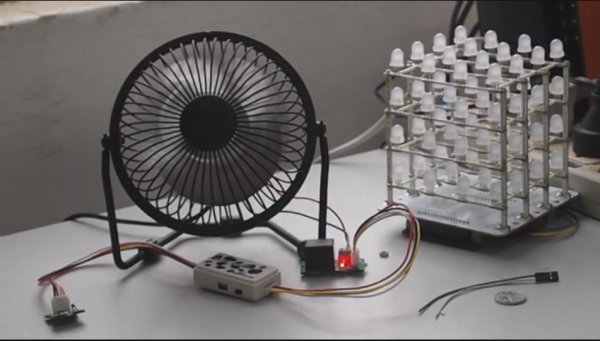
Step 1:
The structure of USB fan is pretty simple. When you break it down(or even you don’t need to, just think in your mind), you can find it just consists of a motor and a key. To make it controllable, turn it over, screw out the screws then we can continue to the next step.
Step 2: Solder the controlling wires
First of all, you need two wires. Then solder them on two ends of the key. It doesn’t matter which side is positive and which side is negative. They function in the same way.
Step 3: Wire up the Relay
Step 4: Combine the stuff
The temperature sensor, relay board and MilCandy are all members of Grove plug-and-play system. In this step, find two Grove cables to connect all the stuff. The “eye” of the MilCandy, AKA temperature sensor, should be connected to the input side of MilCandy. And the “hand”, AKA relay, should be connected to the output side of it. Then they are ready to go.
For more detail: Temperature-controlled USB fan using Arduino
- How do I make the USB fan controllable?
You must solder two wires to the two ends of the key on the fan. - Does polarity matter when soldering the controlling wires?
No, it does not matter which side is positive or negative as they function the same way. - What system connects the temperature sensor and relay board?
The Grove plug-and-play system connects all the components together. - Where should the temperature sensor be connected?
The eye of the MilCandy, which acts as the temperature sensor, connects to the input side. - Which component connects to the output side of the MilCandy?
The hand, which is the relay, connects to the output side. - What tools are needed to access the internal parts of the fan?
You need to turn the fan over and screw out the screws to break it down. - Can this project be done without fully disassembling the fan?
The text suggests you can think about the structure in your mind without needing to break it down first. - What is the main benefit of refitting the fan with a relay and sensor?
The fan can execute its duty automatically without requiring a direct order from the user.
