
Summary of SAELIG INTRODUCES AARONIA AARTOS DRONE/UAV DETECTION SYSTEM
Saelig Company introduced the Aaronia AARTOS Drone Detection System, a customizable passive DDS offering 360° coverage and wideband sensing up to 20 GHz, capable of virtually unlimited detection range and early warning by detecting drone radio links. It uses AI to reduce false alarms, supports portable, mobile, or fixed deployments and sensor networking, can locate operators and estimate distance/altitude with multiple antennas, and detects drones in 10 μs–500 ms depending on configuration.
Parts used in the Aaronia AARTOS Drone Detection System:
- AARTOS DDS V6 unit
- IsoLOG 3D DF antenna arrays
- Multiple sensor nodes (for networked deployments)
- Central monitoring center with remote-control interface
- Portable or mobile mounting hardware (for portability)
- Fixed station mounting hardware (for permanent installations)
- AI software for signal classification and false-alarm reduction
Customizable drone detection systems with 360deg coverage, wideband sensing to 20GHz, and AI software to avoid false alarms
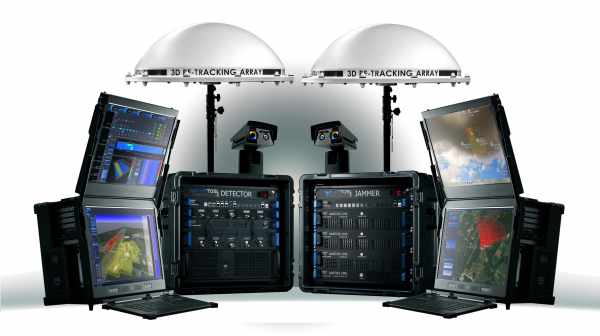
Saelig Company, Inc. has introduced the Aaronia AARTOS Drone Detection System, which can sense airborne drone activity with a virtually unlimited detection range. The AARTOS DDS monitors the entire frequency spectrum (e.g. 100MHz – 20GHz) hundreds of times per second with 360° dome coverage for airborne activity, and is fully customizable depending on the application and situation. It can be configured as a portable or mobile system, or a fixed station with an unlimited number of sensors to form a network covering large areas, and there are no inherent limitations in terms of altitude and elevation. All systems can be linked to a single monitoring center with remote-control for each individual setup. The latest AARTOS DDS V6 generation can detect a DJI Phantom 4 FCC drone at 50 km or more, but the specific range depends on factors such as drone type and topography. The AARTOS DDS uses AI techniques to distinguish between drones and other airborne objects, minimizing the likelihood of false alarms. It is an entirely passive system and does not emit any radiation which could interfere with other infrastructure.
Detecting a drone may take the DDS system between 10μs to 500ms, depending on the configuration and the number of IsoLOG 3D DF antenna arrays. A drone even can be detected as soon as its operator establishes a radio link (i.e. the drone and/or the remote control are switched on). The process of pairing, radio link, take-off, and climb usually takes between 30 seconds and five minutes, depending on the drone model (e.g. the DJI Mavic Pro). This allows the AARTOS DDS a unique early-warning capability by detecting the drone even before it can take off. Optical, acoustic or radar-based drone detection solutions are not able to perform this kind of early-warning detection. The AARTOS DDS can even detect the drone operator’s location. It can track the operator’s movements even if drone and operator are operating at different frequencies or bands. With two systems it is possible to accurately estimate the distance of the drone, and an AARTOS DDS system with two or more antennas can also estimate the drone’s altitude.
Read more: SAELIG INTRODUCES AARONIA AARTOS DRONE/UAV DETECTION SYSTEM
- What frequency range does the AARTOS DDS monitor?
The AARTOS DDS monitors the entire frequency spectrum up to about 20 GHz (example range 100 MHz to 20 GHz) as described in the article. - Can the AARTOS DDS provide full 360 degree coverage?
Yes, the system provides 360° dome coverage for airborne activity. - How does the AARTOS DDS reduce false alarms?
It uses AI techniques to distinguish drones from other airborne objects, minimizing false alarms. - Is the AARTOS DDS active or passive?
The AARTOS DDS is entirely passive and does not emit radiation. - How quickly can the AARTOS DDS detect a drone?
Detection can take between 10 microseconds and 500 milliseconds depending on configuration and number of IsoLOG 3D DF antenna arrays. - Can the system detect a drone before takeoff?
Yes, it can detect a drone as soon as its operator establishes a radio link, providing early-warning before takeoff. - Can AARTOS DDS locate the drone operator?
Yes, the system can detect and track the drone operator’s location, even if operator and drone use different frequencies. - Does the AARTOS DDS have range or altitude limitations?
The system has virtually unlimited detection range with no inherent altitude or elevation limitations, though specific range depends on drone type and topography; AARTOS DDS V6 can detect a DJI Phantom 4 FCC at 50 km or more under some conditions. - Can multiple AARTOS systems be networked?
Yes, an unlimited number of sensors can form a network linked to a single monitoring center with remote control for each setup.
