
Summary of MEET THE LINDENIS V536 SOM & SBC DESIGNED FOR AI VIDEO PROCESSING AND 4K ENCODING
The Lindenis V536 is a SoM + baseboard single-board computer using an Allwinner dual Cortex-A7 and single MIPI CSI interface, targeted at 4K camera, media player, and low-latency A/V streaming applications. It supports open-source stacks (Live555, V4L2, FFmpeg), extensive ISP features (mirroring, color, bad pixel and lens shading correction, contrast/sharpness enhancement, motion/color noise removal), real-time multi-stream and ROI encoding, and MJPEG/JPEG baseline encoding. The expansion board provides various I/O, storage, audio, display, USB, network, wireless, SIM/cellular options, and multiple power inputs.
Parts used in the Lindenis V536:
- Allwinner dual Cortex-A7 processor (SoM)
- Single MIPI CSI camera interface
- Expansion baseboard (130 x 85 mm)
- DVP connector for camera input
- eMMC flash module connector
- MicroSD card slot
- Analog microphone jack
- 3.5 mm line in jack
- 3.5 mm line out jack
- 14-pin I2S header
- 3-pin ADC header
- 3-pin EINT GPIO header
- 4-pin TWI header (1 TWI and S-TWI)
- HDMI 1.4 port
- SRGB LCD interface
- 4-lane MIPI-DSI + touch panel interfaces
- 2x USB 2.0 ports
- 1x Micro USB port
- Power button
- U-boot button
- Gigabit Ethernet RJ45
- Wi-Fi/BT module header
- SIM card slot
- Optional cellular module
- 5V/2A micro USB power input
- 5V/2A DC jack power input
- 3.7V battery connector
- 20-pin power supply header
Similar to the earlier Lindenis V5 designed for AI video processing and 4K encoding, Lindenis has released another single-board computer that uses SoM and baseboard design for 4K camera applications called the Lindenis V536.
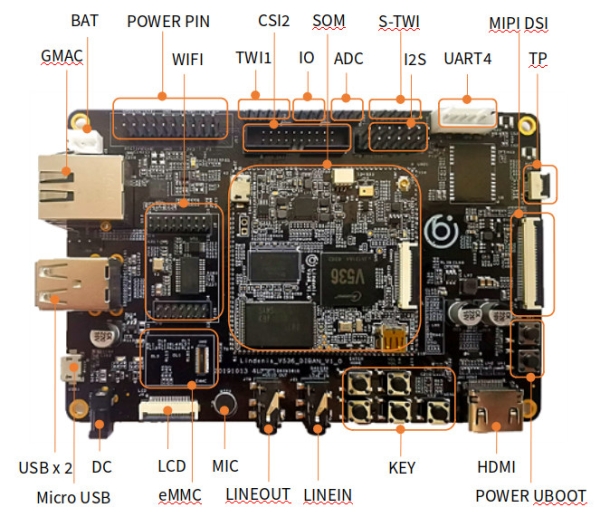
The Lindenis V536 which runs on a new Allwinner dual Cortex-A7 processor and a single MIPI SCI interface was designed for applications that rely heavily on popular open-source packages such as Live555, V4L2, FFmpeg and custom framework, and libraries. Capable of doing a lot on image signal processing and video encoding/decoding functions, the Lindenis V536 is suitable for sample applications like 4K camera applications, media player applications, and low-latency A/V streaming applications. It supports functions like image mirroring and flipping, color enhancement and adjustment, bad pixel, and lens shading correction, providing ISP tools for the PC, contrast and sharpness enhancement, motion smear and color noise removal, real-time multi-stream encoding capability, eight ROI encoding as well as MJPEG / JPEG baseline encoding.
Hardware features and specifications include:
Expansion board
- Dimension: 130 x 85mm
- 1 DVP connector for camera input
- eMMC flash module connector and MicroSD card slot for storage
- Analog microphone and 3.5mm line in and out jacks for audio
- 14-pin I2S header, 3-pin ADC header, 3-pin EINT – GPIO header and 4 –pin TWI header with 1 TWI and S-TWI each
- HDMI 1.4 port, SRGB LCD interface, and 4-lane MIPI-DSI + TP interfaces,
- 2x USB 2.0 ports and 1x Micro USB port
- Power and U-boot buttons
- Connectivity – Gigabit Ethernet (RJ45), Wi-Fi/BT module header, SIM card slot, and optional cellular module.
- Power supply – 5V/2A micro USB connector, 5V/2A via DC jack, 3.7V battery connector, and 20-pin power supply header
Read more: MEET THE LINDENIS V536 SOM & SBC DESIGNED FOR AI VIDEO PROCESSING AND 4K ENCODING
- What processor does the Lindenis V536 use?
The Lindenis V536 uses an Allwinner dual Cortex-A7 processor. - Can the Lindenis V536 handle 4K camera applications?
Yes, it is designed for 4K camera applications and supports extensive ISP and encoding features suitable for that use. - What camera interface is available on the Lindenis V536?
It provides a single MIPI CSI interface and a DVP connector for camera input. - Does the Lindenis V536 support open-source media stacks?
Yes, it was designed to work with Live555, V4L2, FFmpeg and custom frameworks and libraries. - What video encoding features does the Lindenis V536 offer?
It supports real-time multi-stream encoding, eight ROI encoding, and MJPEG/JPEG baseline encoding. - What ISP functions are supported by the Lindenis V536?
Supported ISP functions include image mirroring and flipping, color enhancement and adjustment, bad pixel and lens shading correction, contrast and sharpness enhancement, motion smear and color noise removal, and PC ISP tools. - What display outputs are available on the expansion board?
The expansion board offers HDMI 1.4, an SRGB LCD interface, and 4-lane MIPI-DSI plus touch panel interfaces. - What storage options are available on the Lindenis V536 expansion board?
It includes an eMMC flash module connector and a MicroSD card slot for storage. - What connectivity options are provided?
Connectivity includes Gigabit Ethernet (RJ45), a Wi-Fi/BT module header, a SIM card slot, and an optional cellular module. - What power inputs does the Lindenis V536 support?
Power options include a 5V/2A micro USB connector, 5V/2A via DC jack, a 3.7V battery connector, and a 20-pin power supply header.
