
Summary of LOW RES ARDUINO THERMAL CAMERA
The article describes an Arduino-based low-resolution thermal camera project using an inexpensive 8×8 IR sensor and an 8×8 LED panel. The builder adapts libraries, maps HSV values to the LED array, and demos real-world results versus interpolated commercial modules and phone-based thermal cameras, noting the DIY approach is cheaper and educational though image quality is limited.
Parts used in the LOW RES ARDUINO THERMAL CAMERA:
- Arduino (implied microcontroller)
- 8×8 IR sensor (inexpensive 8x8 thermal sensor)
- 8×8 LED panel
- Wiring/connectors
- Power source for Arduino and LED panel
- Libraries/software for sensor reading and LED driving
Do you know how you see those cheap telescopes at the department store? The box has beautiful pictures that probably came from the Hubble. What you will see is somewhat different. You have to carefully look at [upir’s] Arduino thermal camera project because it intersperses pictures of what you expect an 8×8 sensor will produce with images produced by a much better camera.
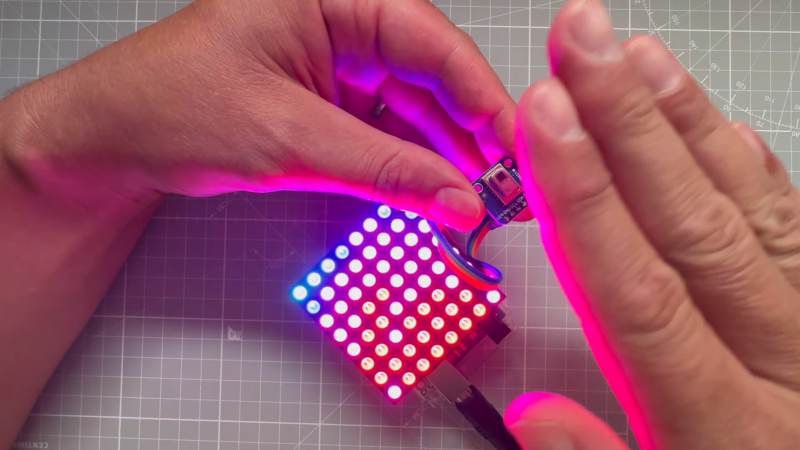
The actual project — watch the video below — is undoubtedly neat. An inexpensive 8×8 IR sensor and an 8X8 LED panel join to form a crude but usable thermal camera.
He leverages several ready-made libraries and walks through how and why he chose them and how he had to modify them. We enjoyed the demo of plotting HSV values to the LED array instead of the usual RGB values.
Given canned code to read the sensor and drive the LEDs, the rest is easy. Of course, like the dime-store telescope, you aren’t going to get amazing results. On the other hand, you probably have everything you need except the $20 sensor sitting around doing nothing anyway.
At around the ten-minute mark, he shows the same sensor in a commercial module that interpolates a higher resolution to an LCD. Still crude, so he also gives a quick review of a commercial camera that plugs into your phone. (You can ignore the video from here on if the stealth advertising bugs you.) We’ve actually looked at that camera before. We’ve also looked at some of the competition. While any of those will beat the 8×8 Arduino camera, they’ll cost more and won’t give you the satisfaction of building it, either.
Source: LOW RES ARDUINO THERMAL CAMERA
- What sensor resolution does the project use?
The project uses an 8×8 IR thermal sensor. - Can an 8×8 sensor produce high-quality images like Hubble photos?
No, the article notes the results are crude and much lower quality than high-end cameras. - What display is used to show thermal data?
An 8×8 LED panel is used to display the thermal image. - Does the project require custom code?
The builder leverages ready-made libraries and modifies them as needed to read the sensor and drive the LEDs. - How are colors mapped to the LED array?
The project demonstrates plotting HSV values to the LED array instead of the usual RGB values. - Is a commercial interpolating module better than the DIY 8×8 setup?
Commercial modules interpolate to higher resolution and give cruder but higher-resolution output than the raw 8×8, though still limited. - Will a phone plug-in thermal camera outperform the Arduino project?
Yes, the article says commercial phone-based thermal cameras beat the 8×8 Arduino camera but cost more and lack the DIY satisfaction. - How much does the 8×8 sensor cost as mentioned?
The article mentions the sensor costs about $20.
