
Summary of Choosing $1 sound card for DC-capable low speed oscilloscope
This article details the modification of a $1.1–$2 C-Media USB sound card (HX2010-0705) into a low-speed oscilloscope. The device, a composite unit with audio and HID inputs, is adapted by desoldering capacitor C6 and adding a 120k series resistor to extend the voltage measurement range to 0–6V. Users must disable AGC and set fixed volume in Windows 7 to ensure accurate readings. The project highlights cost-effective hardware hacking for DIY electronics testing.
Parts used in the C-Media USB Sound Card Oscilloscope:
- C-Media USB Headphone Set (VID=0x0D8C PID=0x000C)
- HX2010-0705 Chip
- Capacitor C6 (80nF)
- 120k Resistor
- Windows 7 Operating System
- Miniscope v2c firmware/DLL
This USB sound card that presents itself as C-Media is one of the cheapest sound cards available with price $1.1-$2 depending on vendor.
Device markings: HX2010-0705, production date 40th week of 2013 (or later?).
Device enumerates as composite device: sound card + HID input. HID input part is used for audio volume and mute control and it functionality is slightly broken – same as with multimedia keyboard it controls default sound card settings, not necessary settings for this specific device.
USB descriptor dump:
VID=0x0D8C PID=0x000C
Product string: C-Media USB Headphone Set
Audio Device Class + HID (composite device)
Judging by the descriptors chip inside is identical as in previously described “C-Media” sound card version without any control keys.
Unlike the previous “C-Media” USB sound card I’ve tested and similar card from this thread it was easy to find point where DC signal component is not blocked:
Notes:
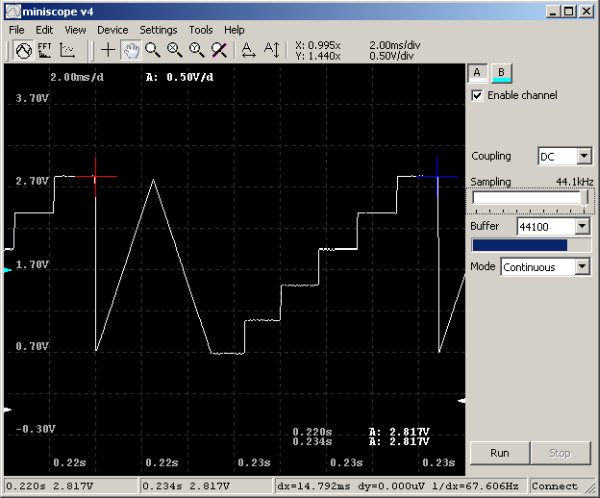
- audio input is mono and two “live” contacts of mic jack are physically shorted together; DLL is intented to be generic (handle stereo cards also), but 2nd channel can be disabled (i.e. hidden) in GUI:
- according to device properties reported by Win7 it offers 44100 and 48000 Hz sampling
- there is 2.23V voltage (DC offset for ADC) on the C6; output impedance of this offset source is relatively high – short-circuit current is 20uA; adding 120k resistor in series reduces it to 8uA
- resistor in series (I’ve used 120k and software is calibrated for it by default) seems like the cheapest way to extend measured voltage range to 0-6V; noise measured in this configuration = 20mVpp
- make sure to disable AGC and set fixed volume (by default plugin is calibrated for Volume = 0) for sound input associated with card (Win7 below):
- C6 capacitor has to be desoldered – its measured capacity is 80nF and it is connected with power supply for mic thus it would severely limit usable frequency range if we’d use additional resistor in series
Beware that with this simple setup oscilloscope input would be equivalent to 2V voltage source with 250k resistance in series. It may be not suitable for circuits with e.g. weak pull-ups. Input buffer would fix it but I’m not considering it economically justified as base STM32F103 board that doesn’t have this problem (and is usable with miniscope v2c firmware/DLL) costs ~$4.
Other approach to building input stage: http://www.epanorama.net/newepa/2012/05/08/usb-soundcard-to-digital-storage-oscilloscope/ (I haven’t tested it yet but it’s simple and looks promising).
Don’t judge a book by its cover (thanks to Daniel Montalvo) – it looks like othes type of sound card is sharing almost the same package:
Read more: Choosing $1 sound card for DC-capable low speed oscilloscope
- What is the price range of this sound card?
The price ranges from $1.1 to $2 depending on the vendor. - How can I extend the measured voltage range to 0-6V?
Add a 120k resistor in series with the input signal. - Does the microphone input support stereo recording?
No, the audio input is mono, and the two live contacts of the mic jack are physically shorted together. - Why must capacitor C6 be desoldered?
It has a capacity of 80nF connected to the mic power supply, which would severely limit the usable frequency range if left in place. - What settings should be configured in Windows 7 for accurate input?
You must disable AGC and set a fixed volume, as the plugin is calibrated for Volume = 0. - What sampling rates does the device offer according to Win7 properties?
The device offers 44100 Hz and 48000 Hz sampling rates. - Is the HID input part fully functional for this specific device?
No, its functionality is slightly broken as it controls default sound card settings rather than settings for this specific device. - What is the noise level when using the 120k resistor configuration?
The noise measured in this configuration is 20mVpp.
