
Summary of BUILDING A DIGITAL COMPASS WITH AN ARDUINO
This article describes a DIY digital compass project using an Arduino Nano and HMC5883L magnetometer to detect magnetic fields. The build features WS2812B LEDs for visual bearing indication and an OLED display showing the current angle relative to magnetic north. It serves as an educational tool for learning electronics and navigation, demonstrating how modern digital sensors can replicate traditional analog compass functionality.
Parts used in the Digital Compass:
- HMC5883L magnetometer
- Arduino Nano
- WS2812B LEDs
- OLED display
The magnetic compass has been a crucial navigational tool for around a thousand years or so, perhaps longer. While classical versions still work perfectly well, you can now get digital magnetometers that work in much the same way. [mircemk] decided to whip up a digital compass to demonstrate the value of these parts.
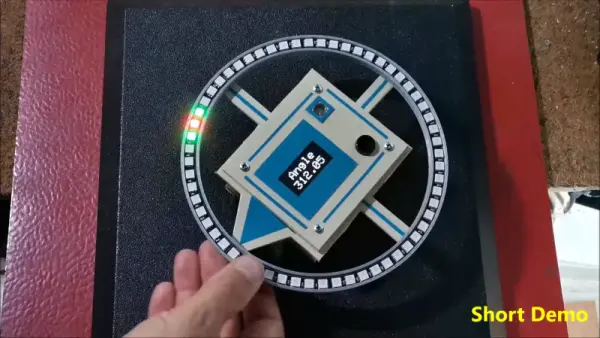
The build uses a HMC5883L magnetometer. While this can detect magnetic fields in three axes, just one is necessary for building a device that operates akin to a traditional compass. The output of the device is read by an Arduino Nano, which is hooked up to a string of WS2812B LEDs and a small OLED display. The LEDs display the bearing of magnetic north, while the OLED screen shows the current angle between the compass’s arrow and magnetic north.
It’s a tidy build that would be a great educational resource for teaching both electronics and navigational skills. We’ve seen similar projects before, like the hilarious Pizza Compass. Video after the break.
Source: BUILDING A DIGITAL COMPASS WITH AN ARDUINO
- What sensor does the project use?
The build uses an HMC5883L magnetometer. - How is the output of the device read?
The output is read by an Arduino Nano. - What do the LEDs display?
The LEDs display the bearing of magnetic north. - What information does the OLED screen show?
The screen shows the current angle between the compass arrow and magnetic north. - Does the project require all three axes of the magnetometer?
No, just one axis is necessary for building a device that operates akin to a traditional compass. - What is the purpose of this build?
It demonstrates the value of digital magnetometers and serves as an educational resource. - Can classical versions of compasses still work?
Yes, classical versions still work perfectly well. - Is there a video available for this project?
Yes, a video is provided after the text break.
