
Summary of Arduino automatic robotic chess board
This article details a DIY automatic robotic chess board project by YouTuber Greg06, featuring on the Arduino Blog. The system uses a two-axis CoreXY gantry with pulleys and belts to move pieces via an electromagnet, controlled by an Arduino Nano. It detects piece positions using an 8×8 reed switch matrix processed through multiplexers and displays menus on an LCD.
Parts used in the Automatic Robotic Chess Board:
- Arduino Nano development board
- A4988 drivers
- MOSFET for driving the magnet
- Two limit switches for homing
- CoreXY gantry system components (pulleys and belts)
- Two stationary stepper motors
- Electromagnet
- 8×8 matrix of reed switches
- Four multiplexers
- 16×2 character LCD
Chess players who would like to build their very own automatic robotic chess board are sure to enjoy a new project published by YouTuber Greg06. Featured on the official Arduino Blog the chessboard allows you to play against remote players with the robotic two-axis gantry system hidden underneath the chessboard moving pieces magically for you. Check out the demonstration video below to learn more about the build.
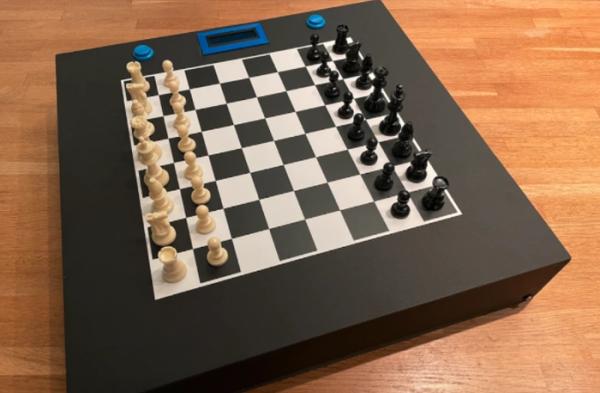
Maker Greg06 has kindly published details of the project to the Instructables website providing details on all the pieces you will need to be able to build your very own. Together with full instructions on how to assemble everything from the pulleys to programming the Arduino Nano development board.
Robotic chess board
“At the base of the gameboard is a two-axis gantry system, which is responsible for moving the chess pieces positioned above via an electromagnet. And rather than placing one stepper motor on each axis, the gantry takes advantage of the CoreXY concept which can move the magnet in all directions with a complex arrangement of pulleys, belts, and two stationary stepper motors. Controlling this is a single Arduino Nano connected to a pair of A4988 drivers, a MOSFET for driving the magnet, and two limit switches for homing.”
“The game is able to determine which piece was moved and to which specific grid square via an 8×8 matrix of reed switches that close a circuit whenever there is a magnet nearby. To save on GPIO pins, four multiplexers were added in order to take the 64 incoming values from the switches and convert it into a single 6-bit value. Finally, a 16×2 character LCD was included for providing instructions/menus to the player(s).”
Source: Arduino automatic robotic chess board
- How does the robotic system move the chess pieces?
The system uses a two-axis gantry with a CoreXY concept driven by two stationary stepper motors and a complex arrangement of pulleys and belts to move an electromagnet. - What controls the movement of the gantry?
An Arduino Nano connected to a pair of A4988 drivers controls the movement. - How does the board detect which piece was moved?
An 8×8 matrix of reed switches closes a circuit whenever there is a magnet nearby to determine the specific grid square. - Why were four multiplexers added to the project?
They were added to save GPIO pins by converting 64 incoming values from the switches into a single 6-bit value. - What component provides instructions or menus to the player?
A 16×2 character LCD is included for providing instructions and menus. - Can this board be used to play against remote players?
Yes, the chessboard allows users to play against remote players while the robotic system moves the pieces automatically. - Where can I find the full assembly instructions for this project?
Maker Greg06 has published the details and full instructions on the Instructables website. - Does the design use one stepper motor per axis?
No, rather than placing one motor on each axis, it uses two stationary stepper motors with a CoreXY arrangement.
