
Summary of 3.7V Li-Ion Battery Charger Circuit
This article describes a 3.7V Li-ion battery charger circuit using the MCP73831 SOT-23-5 linear charge-management IC implementing CV/CC charging with selectable preconditioning and termination. It warns about Li-ion charging safety, notes SMD soldering can be challenging for beginners, and suggests using ready-made modules (e.g., TP4056-based boards) if SMD assembly is difficult.
Parts used in the3.7V Li-Ion Battery Charger Circuit:
- MCP73831 (SOT-23-5) charge management IC
- 3.7V Li-Ion battery (cell)
- 5V DC power supply (USB, solar panel, etc.)
- SMD passives (resistors and capacitors as per circuit)
- PCB or prototyping board for SMD assembly
- Soldering tools and SMD soldering equipment
- Optional readymade TP4056-based charging module
Here is a tried and tested sample circuit of a Li-Ion battery charger that can be used to charge any 3.7V Li-Ion battery using a 5VDC (USB, Solar Panel…) power supply. At the heart of the circuit is one microchip MCP73831, available in SOT-23-5 package. MCP73831 is a highly advanced linear charge management controller for use in space-limited, cost-sensitive applications. This IC employs a constant current/constant voltage charge algorithm with selectable preconditioning and charge termination.
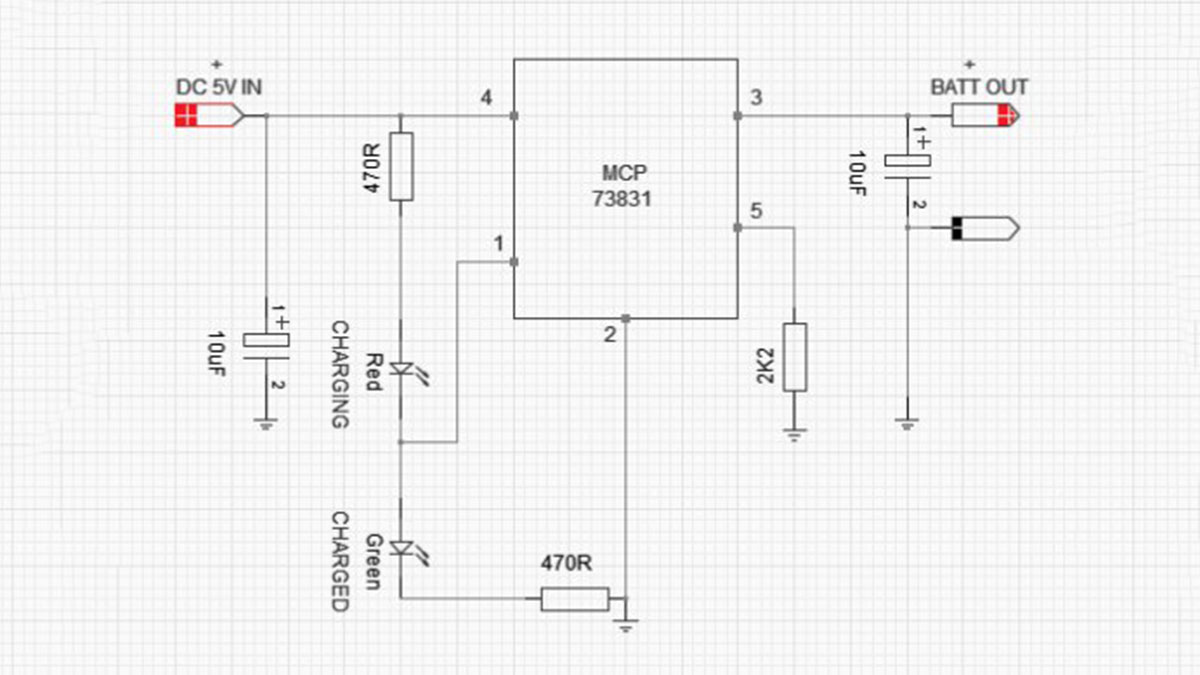
Lithium-ion batteries have become popular for portable electronics because they boast the highest energy density of any commercial battery technology. Benefits include thousands of recharges and no occurrence of the “memory effect” that infested early NiCd rechargeable cells. However, Li-ion batteries need to be charged following a carefully controlled constant current/constant voltage (CV-CC) pattern that is unique to this cell chemistry. Overcharging and careless handling of a Li-ion cell can cause permanent damage, or instability and potential danger!
The SMD Soldering!
Construction of this charger circuit is undoubtedly a difficult exercise for many beginners and hobbysists because the task calls for perfect skill in SMD soldering/prototyping. Fortunately, readymade Li-Ion Battery Charger Modules are now available at many online stores. In case of any difficulty with the task at hand, try to procure one from your favourite online store (recently I bought one – based on IC TP4056 – from here: http://dx.com/p/1a-lithium-battery-chargingmodule-blue-205188)!
FOr More Details: 3.7V Li-Ion Battery Charger Circuit
- What IC is used at the heart of this charger circuit?
The MCP73831 SOT-23-5 charge management IC is used. - Can this charger be powered from USB?
Yes, the circuit can be powered from a 5V DC supply such as USB. - Does the MCP73831 use a specific charging algorithm?
Yes, it employs a constant current/constant voltage (CV/CC) charge algorithm with selectable preconditioning and charge termination. - Are Li-Ion batteries safe to charge without precautions?
No, Li-Ion batteries require carefully controlled CV/CC charging and improper charging can cause damage or danger. - Is SMD soldering required to build this charger?
Yes, construction requires SMD soldering skills which can be difficult for beginners. - What should beginners do if they cannot assemble the SMD circuit?
They can procure readymade Li-Ion charger modules, such as TP4056-based boards, from online stores. - Does the article mention an alternative IC/module recently purchased?
Yes, the author mentions buying a TP4056-based lithium battery charging module.
