
Summary of THIS COMMODORE 16 IS AN NTSC ONE… NO, WAIT, IT’S A PAL ONE!
This article details a modification of an NTSC Commodore 16 home computer to support both PAL and NTSC video standards. The project involves installing a custom ROM containing both system versions and using an Arduino with an Si5351 clock generator to dynamically switch frequencies. A simple interface utilizing the reset button allows users to toggle between modes, effectively making the single machine compatible with different regional TV standards that previously required separate hardware models.
Parts used in the Commodore 16 Dual-Standard Mod:
- Commodore 16 computer (NTSC model)
- Custom ROM
- Arduino microcontroller
- Si5351 clock generator module
- Cut tracks in the crystal oscillator circuit
We’re used to our computers being powerful enough in both peripheral and processing terms to be almost infinitely configurable under the control of software, but there was a time when that was not the case. The 8-bit generation of home computers were working towards the limits of their capability just to place an image on a TV screen, and every component would have been set up to do just the job it was intended for. Thus when different countries had different TV standards such as the mostly-European PAL and the mostly-American NTSC, there would have been different models of the same machine for each market. The Commodore 16 was just such a machine, and [Adrian Black] has modified his NTSC model with a custom ROM, an Arduino and an Si5351 clock generator to be switchable between the two.
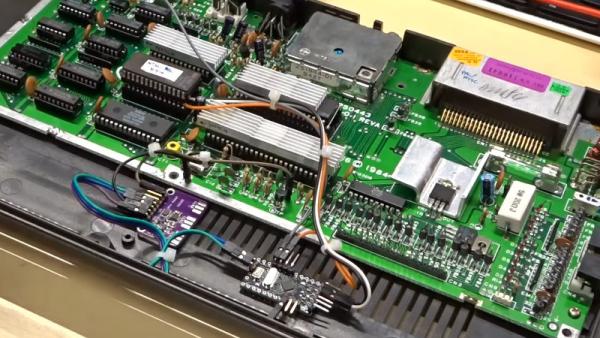
The differences between a PAL and NTSC C16 are two-fold. The clock for the video chip is of a different frequency, and the ROM contents differ too. [Adrian]’s machine therefore has a larger ROM containing both versions which are switchable via one of the upper address lines. A couple of tracks cut in the crystal oscillator circuit allow him to inject a new clock from the Si5351 module, and and Arduino controls everything. The appropriate ROM and clock are selected via a very simple interface, the reset button is captured and while a short press still resets the computer a long one switches the mode.
Despite having its principal engineer, [Bil Herd] as a colleague here at Hackaday, it’s sad that we don’t see as many Commodore 16s as we should. A recent feature showed a 64k C16, but didn’t make it into a C64.
Source: THIS COMMODORE 16 IS AN NTSC ONE… NO, WAIT, IT’S A PAL ONE!
- Why were different models needed for PAL and NTSC regions originally?
Different countries had different TV standards requiring distinct clock frequencies and ROM contents for each market. - What components allow this Commodore 16 to switch between standards?
The project uses a custom ROM, an Arduino, and an Si5351 clock generator. - How does the user switch between PAL and NTSC modes?
A long press on the reset button switches the mode while a short press resets the computer. - What physical modifications are made to the original circuit?
Tracks in the crystal oscillator circuit are cut to inject a new clock signal from the Si5351 module. - How is the correct ROM version selected for the active region?
The larger custom ROM contains both versions and they are switched via one of the upper address lines. - What specific differences exist between PAL and NTSC C16 machines?
The video chip clock frequency and the ROM contents differ between the two standards. - Can this modification be applied to any Commodore 16 model?
The article describes modifying an NTSC model to become switchable, implying the base hardware must accept these changes.
