
Summary of THIS ARDUINO DEBUGGER USES THE CH552
The article explains using a cheap CH552 8-bit USB microcontroller board as a debugging dongle to enable classic ATMega Arduino debugging via the latest Arduino IDE. It highlights available design files and firmware on GitHub, notes the CH552’s low cost and suitability, and frames this approach as an affordable alternative to expensive in-circuit emulators by leveraging chip debugging hardware and reverse-engineered protocols.
Parts used in the Arduino Debugger project:
- CH552 8-bit USB microcontroller board (breakout)
- Design files and firmware from GitHub (for the CH552)
- Classic ATMega Arduino board (target for debugging)
- USB cable (to connect CH552 to host PC)
- Connections/wiring between CH552 and ATMega debug pins
One of the things missing from the “classic” Arduino experience is debugging. That’s a shame, too, because the chips used have that capability. However, the latest IDE has the ability to work with external debuggers and if you want to get started with a classic ATMega Arduino, [deqing] shows you how to get started with a cheap CH552 8-bit USB microcontroller board as the debugging dongle.
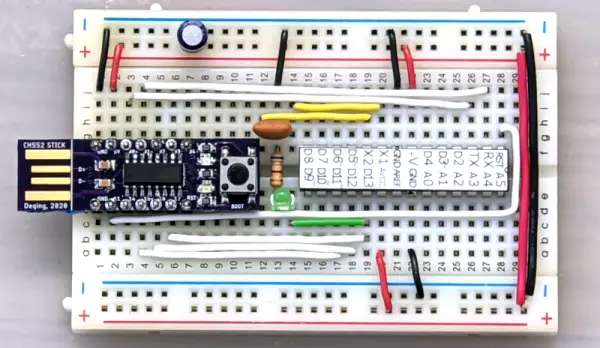
The CH552 board in question is a good choice, primarily because it is dirt cheap. There are design files on GitHub (and the firmware), but you could probably pull the same trick with any of the available CH552 breakout boards.
There was a time when having a god-eye view of your embedded system required an expensive in-circuit emulation system. These were expensive, difficult to deploy, and rare. Then, CPUs started adding debugging hardware right on the chip. A few spare pins on the CPU and some sort of adapter would give you most of what you wanted from an emulation system. Although these adapters are often proprietary, sometimes they aren’t, or they have been reverse-engineered. If you know the protocol, it is easy enough to get a processor to speak it for you. That’s why you often see, for example, Raspberry Pi Picos debugging other Picos. There’s nothing you can’t do a million other ways here, but it is an excellent step-by-step tutorial for getting started without breaking the bank.
Source: THIS ARDUINO DEBUGGER USES THE CH552
- Can a CH552 board be used as a debugger for classic ATMega Arduinos?
Yes, the article shows using a CH552 8-bit USB microcontroller board as a debugging dongle for classic ATMega Arduinos. - Why choose the CH552 board for debugging?
The CH552 is chosen primarily because it is very inexpensive and suitable for this debugging approach. - Are there firmware and design files available for the CH552 debugger setup?
Yes, design files and firmware for the CH552 debugger are available on GitHub as mentioned in the article. - Does the latest Arduino IDE support external debuggers?
Yes, the latest Arduino IDE has the ability to work with external debuggers. - Is this method an alternative to expensive in-circuit emulation systems?
Yes, using the CH552 as a debugger is presented as an affordable alternative to expensive in-circuit emulation systems. - Can other CH552 breakout boards work for this debugging trick?
Yes, the article suggests you could likely use other available CH552 breakout boards to achieve the same result. - Does the article explain why embedded systems debugging became more accessible?
Yes, it explains that CPUs began adding debugging hardware on-chip and that adapters or reverse-engineered protocols make modern debugging accessible.
