
Summary of The Aurora Boxealis – A Color Sensing and Mirroring Project
This project, the "Aurora Boxealis," is an interactive wooden enclosure for a single-board computer that mirrors colors from a swatch placed on top and features a disco party mode. It demonstrates sensor capabilities by using a color sensor to control RGB lights in real-time, offering both calming aurora effects and dynamic light shows triggered by physical interaction.
Parts used in the Aurora Boxealis:
- TS-7970 single board computer
- TCS34725 color sensor
- FadeCandy RGB LED driver
- WS2811 based RGB LED light strip
- Button
- Wooden enclosure
Introduction
Besides looking damned good on an otherwise bland and ordinary desk, this project is about more than just being attention grabbing eye candy. It’s about demonstrating a small portion of our single board computer capabilities by hooking up a color sensor, RGB light strip, and enclosing it in a nice looking wooden enclosure. We’re dubbing it the “aurora boxealis”, and it’s made to stand out from the crowd at trade shows and provide a fun, interactive way to professionally demonstrate an interesting sensor, in this case a color sensor. Grabbing a color swatch from the table and placing it on the top of the box will trigger the lights to mirror that color.
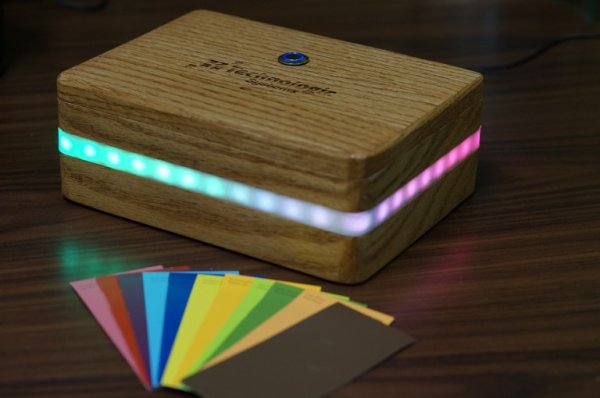
Furthermore, with inspiration from the Celebrationator from “Cloudy with a Chance of Meatballs”, it has a party mode of dancing disco lights which is triggered by pressing the party button on top.
When it’s not partying or matching colors, it displays a calming, color changing effect somewhat reminiscent of the aurora borealis. Take a gander at a full demonstration over on our YouTube channel and then come back for the following details on the build below.
Hardware
The stars of the show are the TS-7970 single board computer, TCS34725 color sensor, FadeCandy RGB LED driver, and RGB LED light strip (WS2811 based). The TS-7970 provides the I/O, power, and processing for the color sensor, FadeCandy, and light strip. The color sensor has everything built-in, including a bright white LED and IR filter. It has an interrupt pin and settings for interrupt thresholds based on the clear light value it reads. The FadeCandy driver is a clever little piece of hardware that utilizes software and firmware to maximize the performance of the RGB LEDs, like for example, color correction and dithering for fantastic color depth. Take a look at their respective product pages for more information. Finally, a button was hooked up to an interrupt pin on the TS-7970 for starting a party.
Read more: The Aurora Boxealis – A Color Sensing and Mirroring Project
- What is the main purpose of the Aurora Boxealis?
To demonstrate single board computer capabilities by hooking up a color sensor, RGB light strip, and enclosing it in a wooden box. - How does the device mirror colors?
Grabbing a color swatch from the table and placing it on the top of the box triggers the lights to mirror that color. - Can the device display a party mode?
Yes, it has a party mode of dancing disco lights which is triggered by pressing the party button on top. - What happens when the device is not matching colors or partying?
It displays a calming, color changing effect somewhat reminiscent of the aurora borealis. - Which single board computer powers this project?
The TS-7970 single board computer provides the I/O, power, and processing for the system. - What specific features does the TCS34725 color sensor have?
It has everything built-in, including a bright white LED and IR filter, plus an interrupt pin with settings for thresholds. - Why is the FadeCandy driver used in this build?
It utilizes software and firmware to maximize performance through color correction and dithering for fantastic color depth. - How is the party mode activated?
A button hooked up to an interrupt pin on the TS-7970 starts the party mode.
