
Summary of The Arduino OctoSynth
The OctoSynth is a polyphonic synthesizer built on an Arduino that generates eight Pulse Width Modulated tones forming a single musical scale. Functioning as an 8-key electronic organ, it allows users to play multiple notes simultaneously within one scale. The project requires specific hardware components and custom code provided by Joe Marshall to operate effectively.
Parts used in the OctoSynth:
- An Arduino
- 12 Male headers (arranged as 2 together, six together, and optionally four together)
- 8 Uniformly LONG Wires (approximately 10 inches or 20 centimeters)
- A Certain Amount of Copper Tape
- Enclosure (such as styrofoam)
- Power Jack and Battery
- Speaker
What is the OctoSynth you may ask? The octosynth is a polyphonic synthesizer that is able to produce eight Pulse Width Modulated tones that form together a musical scale. In English terms, it is a 8 key electronic organ that can play more than one tone at once but only one scale.
Special thanks to Joe Marshall who wrote the very useful code.
As suggested in the title, it runs on Arduino.
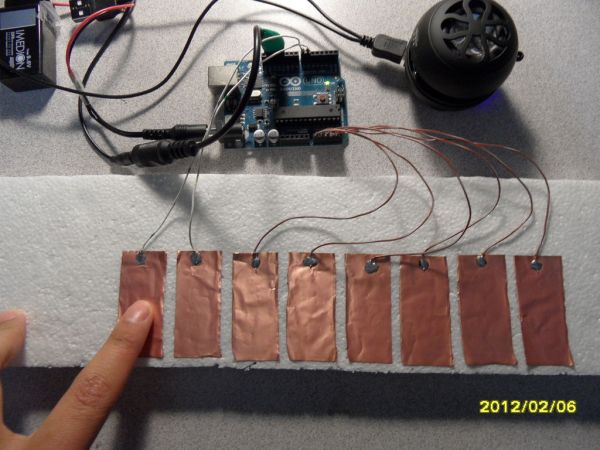
So before we get started, let’s see what is sounds like. Shall, we?
Step 1: Parts of The OctoSynth.
You will need:
An Arduino
12 Male headers (2 together and another six together. Also, another 4 together(Optional))
8 Uniformly LONG Wires ( By long I don’t mean 3 meters but it means a decent 10 inches or maybe, 20 centimeters.)
A Certain Amount of Copper Tape (Get a roll to be safe)
Enclosure (I used styrofoam as a base but if you want an enclosure, which is totally fine, you can use one. The length will depend on the wideness of you choose.)
Power Jack and Battery
Speaker
12 Male headers (2 together and another six together. Also, another 4 together(Optional))
8 Uniformly LONG Wires ( By long I don’t mean 3 meters but it means a decent 10 inches or maybe, 20 centimeters.)
A Certain Amount of Copper Tape (Get a roll to be safe)
Enclosure (I used styrofoam as a base but if you want an enclosure, which is totally fine, you can use one. The length will depend on the wideness of you choose.)
Power Jack and Battery
Speaker
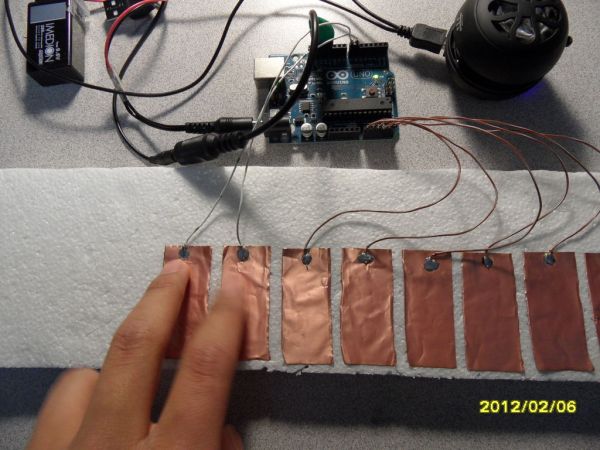
Step 2: Program.
Upload the code below to the Arduino.
Open with the viewer of your choice.
 OctoSynth.pde38 KB
Major Components in Project
An Arduino
12 Male headers
8 Unifomly LONG Wires
A Certain Amount of Copper Tape
Enclosure
Power Jack and Battery
Speaker
12 Male headers
8 Unifomly LONG Wires
A Certain Amount of Copper Tape
Enclosure
Power Jack and Battery
Speaker
For more detail: The Arduino OctoSynth
- What is the OctoSynth?
It is a polyphonic synthesizer that produces eight Pulse Width Modulated tones forming a musical scale. - Can the OctoSynth play more than one tone at once?
Yes, it functions like an 8 key electronic organ that can play more than one tone at once but only one scale. - Does the project run on an Arduino?
Yes, the OctoSynth runs on an Arduino. - Who wrote the code for this project?
Joe Marshall wrote the very useful code used in the project. - How many male headers are needed for the build?
You will need 12 male headers arranged as two together, six together, and optionally another four together. - What length should the wires be?
The wires should be uniformly long, described as about 10 inches or 20 centimeters. - What material can be used for the enclosure?
You can use styrofoam as a base or choose any other enclosure depending on the width you select. - Does the OctoSynth require a speaker?
Yes, a speaker is listed as one of the required parts for the project.
