
Summary of STMICROELECTRONICS INTRODUCES STANDALONE VBUS-POWERED CONTROLLER FOR 5V USB-C CHARGING APPLICATIONS
The STUSB4500L is a compact, standalone USB-C controller IC from STMicroelectronics for pure 5 V sink-only applications. It integrates all mandatory USB-C features for using the connector as a universal 5 V power plug, requires no code or MCU support, is auto-powered from VBUS, prevents leakage and over-voltage damage, and includes dead-battery support, cold-socket behavior, power-budget identification, and error-recovery for safe, fast implementation in low-voltage devices.
Parts used in the STUSB4500L USB-C 5V Charging Project:
- STUSB4500L USB-C controller IC
- USB-C connector
- VBUS power source (5 V USB power supply)
- Optional local battery (not required for STUSB4500L operation)
- Over-voltage protection components (integrated in STUSB4500L)
- PCB and supporting passive components (resistors, capacitors)
The STUSB4500L from STMicroelectronics is a small-footprint addition to the Company’s USB-C controller IC family designed and certified for pure 5 V sink-only applications. All mandatory features to use the USB-C connector as a 5 V universal power plug are integrated, allowing designers to implement USB-C charging solutions quickly and easily without studying the standard or writing code.
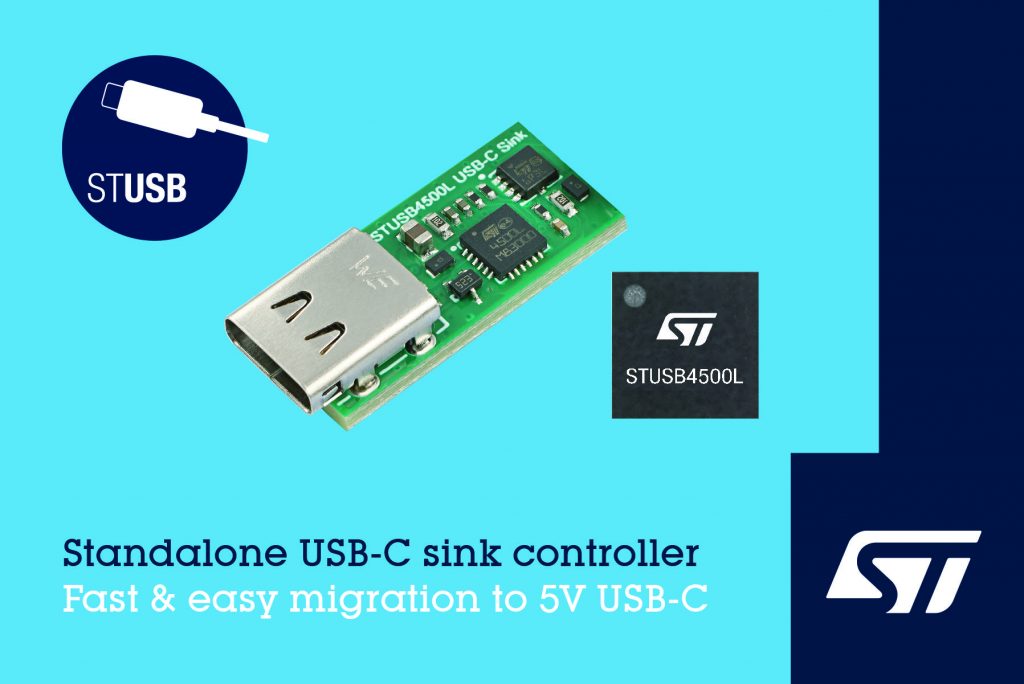
USB-C is rapidly becoming established as a replacement for Micro-B or Mini-B plugs, for both power and data connections, as it offers the advantages of reversible orientation and greater robustness – up to 10,000 connect/disconnect cycles.
ST’s new USB-C controller IC is a stand-alone, plug-and-play interface product, targeting low-voltage applications such as Bluetooth speakers, computer accessories, Wi-Fi access points, point-of-sale equipment, LED lighting, and USB dongles. It can also be used for powering equipment such as single-board computers and hardware development kits. The controller IC runs without additional code and requires no external support from the microcontroller, which eases adoption of the USB-C connector standard by saving time-consuming design work.
The STUSB4500L is auto-powered via VBUS from the connected source and does not need to be supplied from a local battery or on-board power. Zero leakage current prevents draining the battery when not charging. Input over-voltage protection prevents low-voltage equipment being damaged if it is incorrectly connected, for example, to a 20 V source from a USB PD AC adapter rather than the required 5 V supply.
Further features include ‘dead-battery’ support to ensure correct identification by the source when the battery is fully discharged, true cold-socket implementation which keeps the VBUS switch open by default until safe 5 V input power is supplied, source power-budget identification and error-recovery support to ensure correct re-starting when a fault is triggered.
Read more: STMICROELECTRONICS INTRODUCES STANDALONE VBUS-POWERED CONTROLLER FOR 5V USB-C CHARGING APPLICATIONS
- What is the STUSB4500L designed for?
It is designed as a standalone USB-C controller IC for pure 5 V sink-only applications. - Does the STUSB4500L require a microcontroller or code to operate?
No, it runs without additional code and requires no external support from a microcontroller. - How is the STUSB4500L powered?
It is auto-powered via VBUS from the connected 5 V source and does not need local battery power. - Can the STUSB4500L prevent battery drain when not charging?
Yes, it has zero leakage current to prevent draining the battery when not charging. - Does the device protect against input over-voltage?
Yes, it includes input over-voltage protection to prevent damage from incorrect higher-voltage sources. - What dead-battery support features are included?
It provides dead-battery support to ensure correct identification by the source when the battery is fully discharged. - What is cold-socket implementation in this controller?
Cold-socket implementation keeps the VBUS switch open by default until safe 5 V input power is supplied. - Does the STUSB4500L support error recovery?
Yes, it includes error-recovery support to ensure correct restarting when a fault is triggered.
