
Summary of SQUEEZING A MINIMALIST 6502 RETROCOMPUTER ONTO A SINGLE BREADBOARD
This article describes a minimalist 6502 retrocomputer built by [Anders Nielsen] that fits entirely on a single solderless breadboard. By utilizing specialized compact chips like the 28-pin 6507 CPU and the 6532 RIOT, the builder overcame space constraints to create a functional system. The project demonstrates basic capabilities similar to a 555 timer blinker but serves as a proof of concept for extreme hardware miniaturization.
Parts used in the Single Breadboard 6502 Computer:
- 28-pin 6507 CPU (variant of 6502)
- 40-pin 6532 RAM-I/O-timer (RIOT) chip
- 28-pin ROM chip
- 14-pin hex inverter
- Crystal oscillator
- Solderless breadboard
Over the years, and especially lately, we’ve seen tons of single-board retrocomputer builds. That’s fine with us — the more, the merrier. But they all start to run together a bit, with little to distinguish between them. Not so this about-as-compact-as-possible 6502 computer that fits on a single breadboard.
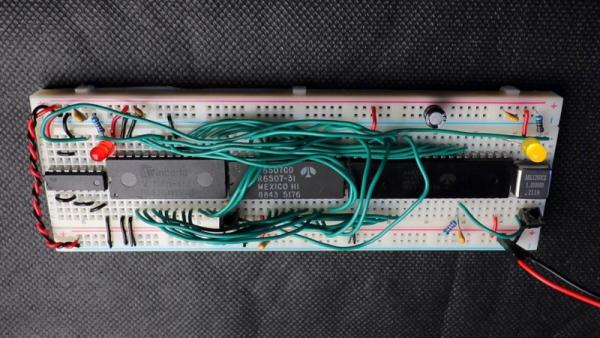
Now, when you do the math, it seems like there’s no way that [Anders Nielsen] would have been able to fit even a minimal chipset onto a standard solderless breadboard. The 40-pin 6502 alone takes up nearly two-thirds of the connections available; add in equally large but necessary chips like the 6522 interface adapter, ROM and RAM chips, and some support ICs, and one breadboard isn’t going to cut it. Luckily, some frugal engineers at MOS back in the 70s came up with the 6507, a variant on the 6502 in a 28-pin DIP. The other key to this build is the 6532 RAM-I/O-timer chip or RIOT, which puts a tiny amount of RAM and some IO lines on a single 40-pin DIP. Along with a 28-pin ROM, a 14-pin hex inverter, and a little crystal oscillator, the entire chipset just barely fits on a single breadboard.
But what can this minimalist 6502 actually do? As you can see in the video below, anything a 555 timer can do, and maybe a little bit more. That’s not a dig, of course — [Anders] actually calls out his initial blinkenlight application as a little more than a glorified 555, and actually comes up with a marginally more complex application just to prove the point. The interesting part here is dealing with the constraints imposed by the limited resources available on this machine.
We’re looking forward to whatever comes next for this clever build. It’s hard to see how some of the plans [Anders] has for it will still fit on a single breadboard, though — these things tend to spread out as they go.
Source: SQUEEZING A MINIMALIST 6502 RETROCOMPUTER ONTO A SINGLE BREADBOARD
- How did the builder fit the chipset onto a single breadboard?
The builder used a 28-pin 6507 variant instead of the standard 40-pin 6502 and utilized the 6532 RIOT chip which combines RAM and IO lines. - What specific chips are required for this minimal build?
The build requires a 6507 CPU, a 6532 RIOT chip, a 28-pin ROM, a 14-pin hex inverter, and a crystal oscillator. - Can a standard 40-pin 6502 fit on one breadboard with other necessary chips?
No, the 40-pin 6502 alone takes up nearly two-thirds of the connections, making it impossible to add other necessary chips on a single board. - What is the main function demonstrated by this computer?
The computer performs tasks similar to a 555 timer, such as blinking lights, though it can handle slightly more complex applications. - Who is the creator of this single breadboard 6502 computer?
The project was created by [Anders Nielsen]. - Why was the 6507 chip chosen over the 6502?
The 6507 was chosen because it is a 28-pin DIP variant of the 6502, saving significant space compared to the 40-pin version. - Does the 6532 chip include memory?
Yes, the 6532 RIOT chip puts a tiny amount of RAM along with some IO lines on a single 40-pin DIP.
