
Summary of SPARKFUN LAUNCHES SPARKX QWIIC COMPATIBLE BOARD TO ENABLE STEPPER MOTOR CONTROL
SparkFun's SparkX Qwiic Step is an experimental Qwiic-compatible board that simplifies stepper motor control via I2C, supports motors up to 2A, includes an emergency stop button, and accepts 8–35V power. Preprogrammed firmware uses the AccelStepper library to handle speed, acceleration, position, micro-step mode, and adjustable hold/run voltages. The board connects to a RedBoard via Qwiic cable and uses ergonomic latch terminals for motor wiring.
Parts used in the Qwiic Step:
- Qwiic Step board (SparkFun SparkX experimental board)
- Qwiic cable
- Stepper motor (up to 2A)
- Power supply (8–35V barrel jack)
- Emergency stop button (built-in on board)
- RedBoard (or compatible microcontroller with Qwiic)
- Ergonomic latch terminals for motor wiring
SparkFun has announced another experimental SparkX board design, which enables higher motor control on a Qwiic-compatible I2C bus, with support for a built-in emergency stop button, and the capability to drive motors requiring up to 2A.
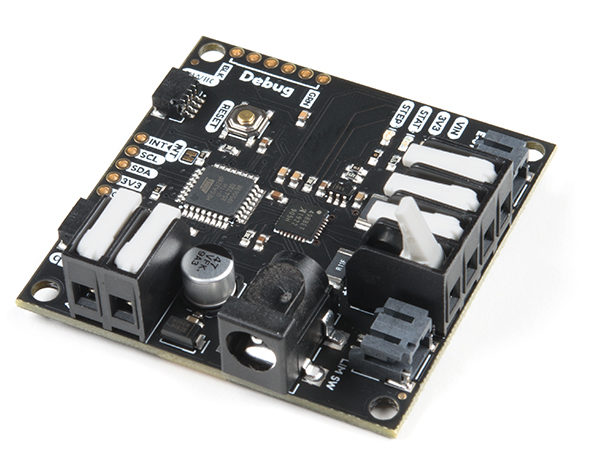
The Qwiic Step is the latest of SparkFun’s entry in the SparkX board family, which are ranges of experimental designs marketed as fully-operational devices, but without guaranteeing them being manufactured regularly in the company’s range, following the release of the Qwiic GPIO add-on board and BlackBoard C Arduino-compatible development board. The Qwiic Step is designed to enable additional functionality to a microcontroller’s I2C bus, which offers Simple control of stepper motors.
The company gives explanations behind the idea of the board:
Ever found controlling stepper motors confusing? There are a huge variety of wires to get connected right: power, motor coils, and control lines. And the tiny screwdriver to adjust the terminals is never where it should be. Qwiic Step simplifies the tangle. Just connect your motor to Qwiic Step using the ergonomic latch terminals, apply 8 – 35V to the barrel jack, and plug in Qwiic Step to your favourite RedBoard with a Qwiic cable.
The company continues:
Qwiic Step comes preprogrammed to accept simple I2C commands, handling all the complex stepper motor calculations and control. This firmware leverages the AccelStepper library to fine tune each step of the motor. The speed, acceleration, position, and micro-step mode can be configured by the user. Additionally, the hold and run voltage of the motor is adjustable. This allows the user to specify maximum hold and run currents.
Read more: SPARKFUN LAUNCHES SPARKX QWIIC COMPATIBLE BOARD TO ENABLE STEPPER MOTOR CONTROL
- What is the purpose of the Qwiic Step board?
To simplify stepper motor control over a Qwiic-compatible I2C bus, handling motor calculations and control via built-in firmware. - Can the Qwiic Step drive motors that require up to 2A?
Yes, it has the capability to drive motors requiring up to 2A. - What voltage range does the Qwiic Step accept?
It accepts 8–35V applied to the barrel jack. - Does the Qwiic Step include an emergency stop?
Yes, it supports a built-in emergency stop button. - How does the Qwiic Step connect to a microcontroller?
It connects to a RedBoard or compatible microcontroller using a Qwiic cable. - What firmware or library does the Qwiic Step use for motor control?
Its preprogrammed firmware leverages the AccelStepper library to fine tune motor steps. - Can users configure motor speed and micro-step mode?
Yes, speed, acceleration, position, and micro-step mode can be configured by the user. - Is motor hold and run current adjustable on the Qwiic Step?
Yes, the hold and run voltage of the motor is adjustable to specify maximum hold and run currents.
