
Summary of A Smart Night Lamp for Kids
The author built a color-changing night lamp for children using an Arduino Uno. The device activates only in low light via a photoresistor and cycles colors to reduce fear of the dark. It features simple hardware components connected to a breadboard, including an RGB LED and various resistors to manage sensitivity and current flow.
Parts used in the Night Lamp for Kids:
- Arduino Uno
- Jumper wires
- Half Size Breadboard
- Bright RGB Cathode LED
- Photo Resistor
- 2x 220 Ohm Resistors
- 1x 330 Ohm Resistor
- 1x 10K Ohm Resistor
You can download our e-book ‘Learn Arduino from Scratch’ from this link
Few weeks ago I heard my nephew (aged 7) complaining of the dark at night. Basically he was afraid ? So I decided to put knowledge into practice and build a night lamp for kids. Since the project was intended for kids, I thought of making the lamp change color every now and then. It should also be sensitive to light so that if the room is well lit, the lamp would remain off.
For this project Arduino Uno was used.You can use any other Arduino instead, and all should work fine.
Hardware:
- 1x Arduino (ebay)
- Some Jumper wires (ebay)
- 1x Half Size Breadboard (ebay)
- 1x Bright RGB Cathode LED (ebay)
- 1x Photo Resistor (ebay)
- 2x 220 Ohm Resistors (ebay)
- 1x 330 Ohm Resistor (ebay)
- 1x 10K Ohm Resistor (ebay)
Schematic
So basically the idea was that as a first, the lamp should be switched on only when the photo-resistor reading goes below a certain threshold, meaning that the ambient light went down considerably; secondly the lamp should change color at certain intervals. That is why an RGB LED was used.
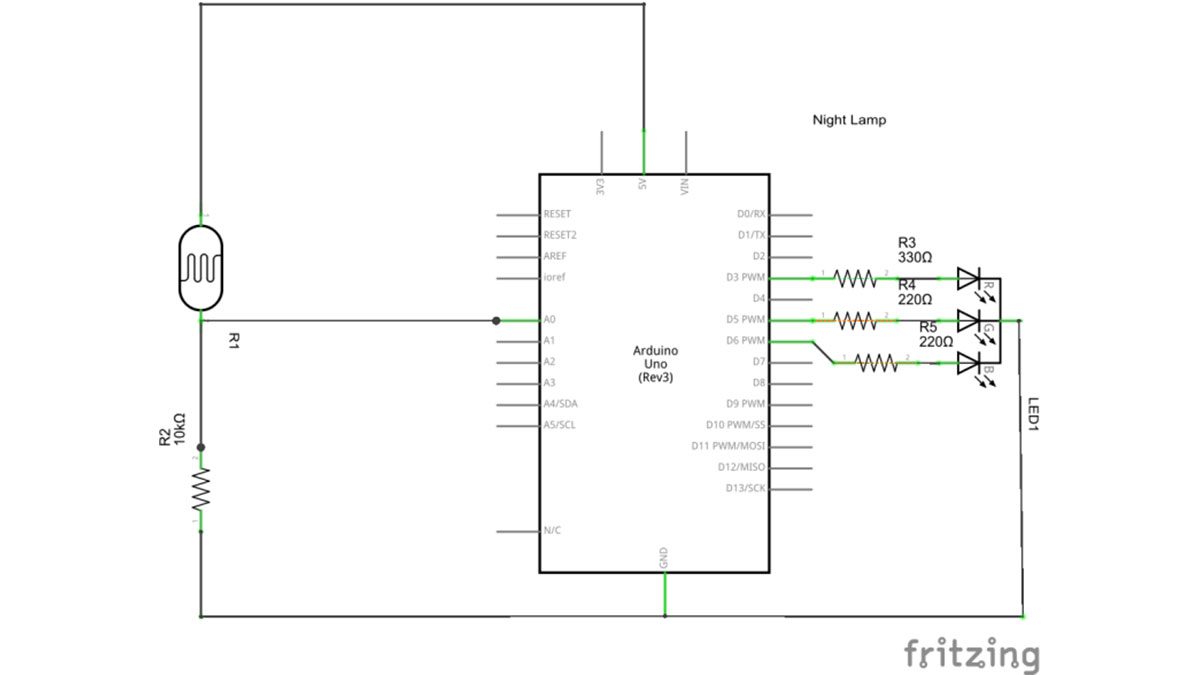
The Photo Resistor or Light Dependent Resistor (LDR) is a resistor which decreases its resistance when exposed to light. This means that the more light the LDR receives the more current passes through it and through the Arduino pin which is then read by the Arduino. The Resistor connected in series with the LDR serves to limit or increase the range of the LDR sensitivity to light. A 10kOhm resistor is a good choice to read ambient light but not if the LDR is exposed to direct sunlight, and also not good for low light conditions because the values saturate rapidly in these extremes.
Read more: A Smart Night Lamp for Kids
- How does the lamp determine when to turn on?
The lamp switches on only when the photo-resistor reading falls below a certain threshold, indicating that ambient light has decreased considerably. - Can I use an Arduino other than the Uno for this project?
Yes, you can use any other Arduino instead, and all should work fine. - What is the function of the resistor connected in series with the LDR?
The resistor serves to limit or increase the range of the LDR sensitivity to light. - Does the lamp change colors automatically?
Yes, the lamp changes color at certain intervals. - Why was an RGB LED chosen for this project?
An RGB LED was used because the lamp needs to change color at certain intervals. - How does a Photo Resistor behave when exposed to light?
The resistance decreases when exposed to light, meaning more current passes through it as light increases. - Is a 10kOhm resistor suitable for direct sunlight conditions?
No, a 10kOhm resistor is not good if the LDR is exposed to direct sunlight. - What happens to LDR values in low light conditions with a 10kOhm resistor?
The values saturate rapidly in low light conditions.
