
Summary of REMOTE-CONTROL KINETIC SAND TABLE USES A SINGLE ARDUINO
This Arduino-driven kinetic sand table converts a coffee table into a mesmerizing art piece where a ball bearing is guided through sand by magnets moved along rails driven by stepper motors. The creator added laser-cut 3mm boards for the sand bed and rail/magnet mounts, used a CNC shield with steppers, and optimized GRBL/g-code to run the mechanism from a single Arduino.
Parts used in the Kinetic Sand Table:
- Coffee table (base furniture)
- 3mm laser-cut board for sand tray
- 3mm laser-cut board for rails and magnets
- Custom laser-cut connector pieces for rails and pulleys
- Rails for magnet carriage
- Pulleys for motion system
- Stack of magnets (magnet carriage)
- Ball bearing (to make tracks in the sand)
- Stepper motors (pair)
- CNC shield
- Arduino (single board to run GRBL)
- Sand (kinetic or regular as used in table)
There’s nothing fun about a Sisyphean task unless you’re watching one being carried out by someone or something else. In that case, it can be mesmerizing like this Arduino-driven kinetic sand table.
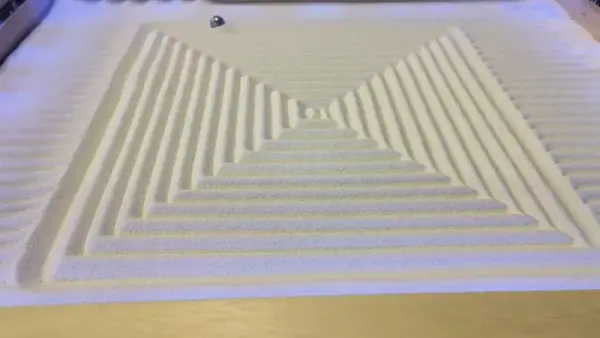
Like many of these builds, it all started with an ordinary coffee table from the hacker’s favorite furnitüre store. [NewsonsElectronics] opened it up and added a 3mm-thick board to hold the sand and another to hold the rails and magnets.
After designing some pieces to connect the rails and pulleys together, [NewsonsElectronics] let the laser cutter loose on some more 3mm stock. A pair of stepper motors connected to a CNC shield do all of the work, driving around a stack of magnets that causes the ball bearing to trudge beautifully through the sand.
Be sure to check out the videos after the break. The first is a nice demonstration, and the second is the actual build video. In the third video, [NewsonsElectronics] explains how they could write the world’s smallest GRBL code to swing this with a single Arduino. Hint: it involves removing unnecessary data from the g-code generated by Sandify.
Don’t have a laser cutter? Here’s a sand table built from 3D printer parts.
Source: REMOTE-CONTROL KINETIC SAND TABLE USES A SINGLE ARDUINO
- What is the primary controller used for the sand table?
The project uses a single Arduino running GRBL to control the sand table. - How are the magnets moved under the sand?
A pair of stepper motors drive a magnet carriage along rails via pulleys to move the magnets. - What parts were laser cut for the build?
3mm boards were laser cut to form the sand tray, the rails and magnet mounts, and connector pieces for rails and pulleys. - Does the build use a CNC shield?
Yes, the stepper motors are connected to a CNC shield. - What creates the visible tracks in the sand?
A ball bearing is guided by the moving magnets to trudge through the sand and create tracks. - Can the GRBL code be simplified to run on one Arduino?
Yes, the builder explains removing unnecessary g-code data generated by Sandify to create a minimal GRBL program for a single Arduino. - Is a laser cutter required to build this project?
No, the article notes an alternative sand table built from 3D printer parts for those without a laser cutter.
