
Summary of RDA5981 is a $1 Fully Integrated WiFi Chip with an ARM Core
The RDA5981 is a low-power, fully integrated WiFi chip by RDA Microelectronics designed for smart home, audio, and IoT devices. It features an ARM Cortex-M4 core running at 160MHz, combining MCU functions with IEEE802.11b/g/n connectivity. The chip emphasizes reduced size and power consumption while offering robust security via hardware accelerators and an onboard TCP stack. Unlike the ESP8266, it includes USB 2.0 support and runs on platforms like Baidu DuerOS.
Parts used in the RDA5981 Project:
- RDA5981 Chip
- ARM Cortex M4 + FPU/MPU Core
- Internal SRAM (Up to 288KByte)
- Wi-Fi Stack SRAM (160Kbyte)
- Flash Memory (Up to 8MB or 32Mbit SPI Flash)
- AES/RSA Hardware Cryptographic Accelerator
- True Random Number Generator
- USB 2.0 Interface
- IEEE802.11b/g/n MAC/PHY/Radio
RDA’s RDA5981 is a fully integrated low-power WiFi chip from RDA Microelectronics. RDA5981 is a fully built WiFi chip highly intended for applications in the areas of a smart home, audio applications and IoT applications. The RDA5981 is being used in devices running Baidu DuerOS, the Chinese alternative to Amazon Alexa or Google Assistant.
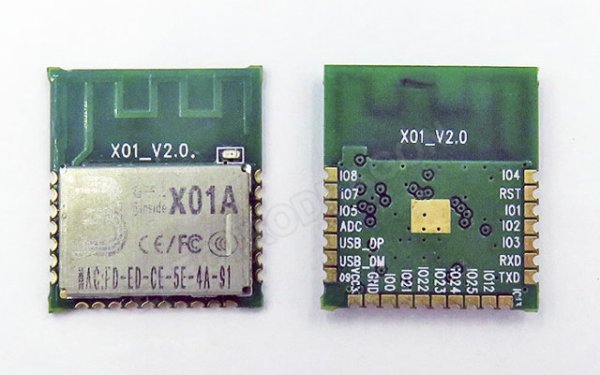
During the annual event of China’s semiconductor industry IC China 2016, RDA Microelectronics announced the RDA5981 during the event with promises of it reducing the size, power consumption, development costs of a smart device.
The RDA5981A is a low power MCU with IEEE802.11b/g/n MAC/PHY/radio integrated into one chip. The RDA5981 is powered by the ARM Cortex M4 plus FPU/MPU core running at 160MHz speed, a high performing processor for that application type. It has up to 288KByte of internal SRAM and additional 160Kbyte SRAM for Wi-Fi stack and flash cache but with only about 192Kbyte available for the user. It has up to 8MB of Flash, 2x ADC with a 10bit resolution, 8x PWM (Pulse Width Modulation), 4x SPI (Serial Peripheral Interface) with a maximum clock frequency of about 20MHz, one I2C, 2x I2S, 2x UART and a total of about 14 GPIO Pins.
Concerned about Security, the RDA5981 has an onboard hardware cryptographic accelerator supporting AES/RSA, and a True Random Number Generator (not the one you use software to generate), and lastly a CRC accelerator for improved performance. It includes an onboard TCP stack which could either support SSL, TLS or even both.
Unlike the ESP8266, one the maker’s favorite Wi-Fi module, the RDA5981 includes USB2.0 features.
RDA5981 A/B/C processor specifications:
- CPU – Arm Cortex-M4 +FPU/MPU core @ up to 160 MHz
- Memory –
- Up to 448 KB SRAM for network stack and application
- User available memory is 192Kbyte
- Storage –
- Up to 32Mbit SPI flash
- Support 64M PSRAM expansion
- Connectivity
- WiFi
- 2.4 GHz 802.11b/g/n WiFi up to 150 Mbps with 20/40 MHz bandwidth
- WPA, WPA2, WEP, TKIP, CCMP security
- STA, softAP, P2P, STA+softAp, STA+P2P modes
- A-MPDU, A-MSDU, HT-BA
- WiFi
Read more: RDA5981 is a $1 Fully Integrated WiFi Chip with an ARM Core
- What applications is the RDA5981 intended for?
The chip is intended for smart home, audio, and IoT applications. - How fast does the processor run?
The ARM Cortex M4 plus FPU/MPU core runs at up to 160MHz speed. - Does the RDA5981 include USB features?
Yes, unlike the ESP8266, the RDA5981 includes USB 2.0 features. - What security protocols are supported?
It supports WPA, WPA2, WEP, TKIP, CCMP, SSL, and TLS. - Can the device expand its memory storage?
Yes, it supports up to 64M PSRAM expansion. - What type of cryptographic accelerator is onboard?
It has an onboard hardware cryptographic accelerator supporting AES and RSA. - How many GPIO pins does the chip have?
The chip has a total of about 14 GPIO Pins. - What is the maximum WiFi data rate?
The WiFi operates up to 150 Mbps with 20/40 MHz bandwidth.
