
Summary of RAK8213 – THE NEW MINI-PCIE CARD FOR NB-IOT AND LTE CAT M1
RAK Wireless introduced the RAK8213, an NB-IoT and LTE Cat M1 module in a mini-PCIe form factor based on the Quectel BG96. It supports global bands, GNSS, and is designed for remote monitoring and smart metering on devices like the Pine H64. Unlike regional competitors, it offers worldwide connectivity via AT commands over USB or UART, compatible with Hologram IoT SIM cards.
Parts used in the RAK8213 Project:
- RAK8213 mini-PCIe card
- Quectel BG96 module
- Pine H64 single-board computer
- Hologram IoT SIM card
- Netbooks or routers with mini-PCIe sockets
- UP AI Core
- PicoEVB
A China-based manufacturer called RAK Wireless has released the RAK833 LoRaWAN gateway module a couple months back. This has already been used hugely to create a gateway for ‘The Things Network’. Now they’re back with the new RAK8213, an NB-IoT and LTE Cat M1 module in the same mini-PCIe form factor as the RAK833. The RAK mini-PCIe card is constructed around the Quectel BG96 module, which provides both NB-IoT and LTE Cat M1 along with GNSS (GPS, GLONASS, Galileo, or BeiDou) support.
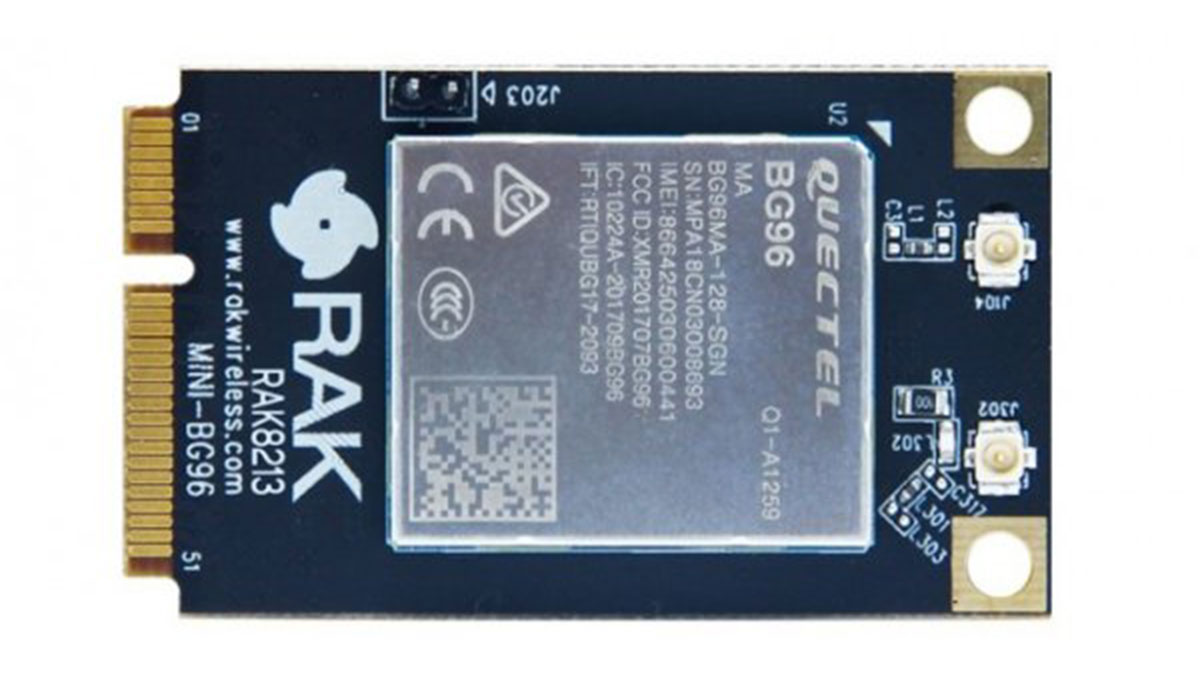
The mini-PCIe form factor is often associated with laptop computers, but recently we’ve started seeing that some single-board computers targeted at the maker market are also featuring this form. The Pine H64 single board computer is an example of it. Besides that, we’ve also noticed the rise of other mini-PCIe modules, such as the UP AI Core, or the PicoEVB, also aimed for makers.
This card can be added to netbooks/notebooks or routers in the mini-PCIe socket. It can be used for remote monitoring, smart meter reading, and so on. The user manual for this card basically explains how the user can send AT commands over USB or UART to the card in Windows, and how to set up the board with Hologram IoT SIM card.
RAK8213 is not the first NB-IoT/eMTC mPCIe card on the market. There are also some SIMCom SIM7000 based modules for about $30. However, it should be noted that the new RAK8213 works globally but SIM7000A / SIM7000C / SIM7000E work in specific regions, namely America, China and Europe.
RAK8213 mini PCIe card key specifications:
- Wireless Connectivity Module: Quectel BG96 with LTE Cat. M1 (eMTC), LTE Cat. NB1 (NB-IoT), EGPRS, and GNSS
- Global bands support :
- FDD-LTE – B1/ B2/ B3/ B4/ B5/ B8/ B12/ B13/ B18/ B19/ B20/ B26/ B28
- TDD-LTE – B39 (for Cat M1 only)
- EGPRS – 850/900/1800/1900Mhz
- Max Data Rate: Cat M1: 375 kbps (UL/DL); Cat NB1: 32 kbps DK, 70 kbps (UL)
- Other I/O:
Read more: RAK8213 – THE NEW MINI-PCIE CARD FOR NB-IOT AND LTE CAT M1
- What core module powers the RAK8213?
The card is constructed around the Quectel BG96 module. - Can the RAK8213 be used globally?
Yes, the RAK8213 works globally unlike some SIMCom modules restricted to specific regions. - How do users send commands to the RAK8213?
Users can send AT commands over USB or UART interfaces. - Does the RAK8213 support GPS tracking?
Yes, it provides GNSS support including GPS, GLONASS, Galileo, and BeiDou. - What are common use cases for this card?
It is used for remote monitoring and smart meter reading. - Which single-board computers feature the mini-PCIe form factor?
The Pine H64 is an example of a single-board computer featuring this form. - What wireless technologies does the Quectel BG96 provide?
It provides LTE Cat M1, LTE Cat NB1, EGPRS, and GNSS support. - How does the RAK8213 compare to SIM7000 modules regarding regionality?
SIM7000 variants work in specific regions while the RAK8213 operates globally.
