
Summary of PicoScope® 5000 Series – Flexible Resolution USB Oscilloscope
This article introduces the PicoScope 5000D FlexRes, a versatile USB oscilloscope designed for debugging diverse signal types. It features hardware that switches between high sampling rates (1 GS/s at 8-bit) and high resolution (62.5 MS/s at 16-bit). The device offers SuperSpeed USB 3.0 connectivity, deep capture memory up to 512 MS, built-in waveform generation, and support for serial decoding protocols.
Parts used in the PicoScope 5000D FlexRes:
- Multiple high-resolution ADCs
- SuperSpeed USB 3.0 connection
- PicoSDK software development kit
- Built-in arbitrary waveform generator
- Deep capture memory (up to 512 MS)
- 16 digital channels (on MSO models)
- Spectrum analyzer (up to 200 MHz)
Today’s electronic designs employ a wide range of signal types: analog, digital, serial (both high- and low-speed), parallel, audio, video, power distribution and so on. All need to be debugged, measured and validated to ensure that the device under test is functioning correctly and within specification.
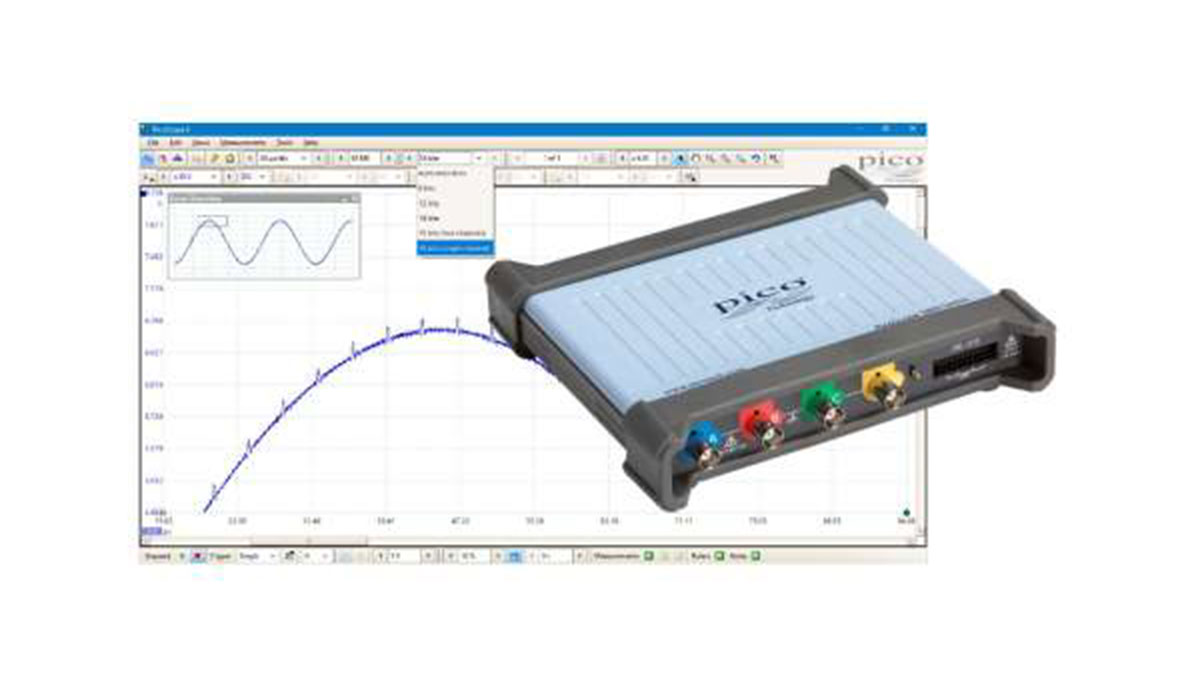
To handle this variety of signal types, PicoScope 5000D FlexRes hardware employs multiple high-resolution ADCs at the input channels in different time-interleaved and parallel combinations to optimize either the sampling rate to 1 GS/s at 8 bits, the resolution to 16 bits at 62.5 MS/s, or other combinations in between – you select the most appropriate hardware resolution for the requirements of each measurement.
2 and 4 channel models are available, all featuring a SuperSpeed USB 3.0 connection, providing lightning-fast saving of waveforms while retaining compatibility with older USB standards. The PicoSDK® software development kit supports continuous streaming to the host computer at rates up to 125 MS/s. The product is small and light, and operates silently thanks to its low-power fanless design.
Specifications
- FlexRes 8 to 16-bit hardware resolution
- Up to 200 MHz analog bandwidth
- 1 GS/s sampling at 8-bit resolution
- 62.5 MS/s sampling at 16-bit resolution
- Up to 512 MS capture memory
- 16 digital channels on MSO models
- 130 000 waveforms per second
- Built-in arbitrary waveform generator
- 18 serial decoding protocols as standard
- Up to 200 MHz spectrum analyzer
Software
PicoScope 5000D Series oscilloscopes have waveform capture memories ranging from 128 to 512 million samples – many times larger than traditional benchtop scopes. Deep memory enables the capture of long-duration waveforms at maximum sampling speed. In fact, the PicoScope 5000D Series can capture waveforms over 500 ms long with 1 ns resolution. In contrast, the same 500 ms waveform captured by an oscilloscope with a 10 megasample memory would have just 50 ns resolution.
Read more: PicoScope® 5000 Series – Flexible Resolution USB Oscilloscope
- How does the PicoScope 5000D optimize measurement requirements?
It employs multiple high-resolution ADCs in different time-interleaved and parallel combinations to select the appropriate hardware resolution. - What is the maximum sampling rate available at 8-bit resolution?
The device can achieve a sampling rate of up to 1 GS/s when operating at 8-bit resolution. - Can this device connect to older USB standards?
Yes, while featuring a SuperSpeed USB 3.0 connection, it retains compatibility with older USB standards. - What is the maximum continuous streaming rate supported by the PicoSDK?
The PicoSDK supports continuous streaming to the host computer at rates up to 125 MS/s. - Does the PicoScope 5000D generate noise during operation?
No, the product operates silently thanks to its low-power fanless design. - What is the longest waveform duration that can be captured with 1 ns resolution?
The series can capture waveforms over 500 ms long with 1 ns resolution due to its deep memory capabilities. - How many serial decoding protocols are included as standard?
The device includes 18 serial decoding protocols as standard. - What is the analog bandwidth specification for this oscilloscope?
The PicoScope 5000D FlexRes features an analog bandwidth of up to 200 MHz.
