
Summary of OTA FLASH TOOL MAKES FITNESS TRACKER HACKING MORE ACCESSIBLE
Aaron Christophel has developed a custom firmware solution for the affordable MPOW D6 fitness tracker, enabling users to write and flash their own code via the Arduino IDE. A new Android application facilitates wireless Over-The-Air (OTA) flashing, eliminating the need for physical programmer connections or opening the device case. This project targets the NRF52832 chip, allowing easy switching between original and custom firmware directly from the wrist while the device is in bootloader mode.
Parts used in the MPOW D6 Custom Firmware Project:
- MPOW D6 Fitness Tracker
- NRF52832 Microcontroller
- Android Application for OTA Flashing
- Customized Arduino IDE
- DFU Firmware Files
Over the last several months, [Aaron Christophel] has been working on creating a custom firmware for cheap fitness trackers. His current target is the “D6 Tracker” from a company called MPOW, which can be had for as little as $7 USD. The ultimate goal is to make it so anyone will be able to write their own custom firmware for this gadget using the Arduino IDE, and with the release of his new Android application that allows wirelessly flashing the device’s firmware, it seems like he’s very close to realizing that dream.
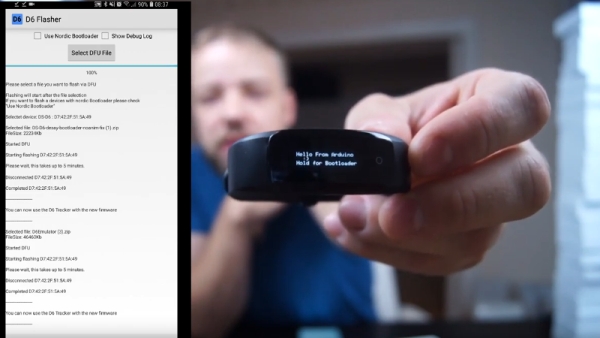
Previously, [Aaron] had to crack open the trackers and physically connect a programmer to update the firmware on the NRF52832-based devices. That might not be a big deal for the accomplished hardware hacker, but it’s a bit of a hard sell for somebody who just wants to see their own Arduino code running on it. But with this new tool, he’s made it so you can easily switch back and forth between custom and original firmware on the D6 without even having to take it off your wrist.
After the break, you can see the video that [Aaron] has put together which talks about the process of flashing a new firmware image. It’s all very straightforward: you simply pick the device from the list of detected BLE devices, the application puts the tracker into bootloader mode, and then you select the DFU file you want to flash.
There are a couple of ready-made firmwares you can put on the D6 right now, but where’s the fun in that? [Aaron] has put together a customized version of the Arduino IDE that provides everything you need to start writing and flashing your own firmware. If you’ve ever dreamed about creating a wearable device that works exactly the way you want, it’s hard to imagine a cheaper or easier way to get in on the action.
When we last heard from [Aaron] earlier this year, he was working on the IWOWN I6HRC tracker. But it looks like the availability of those devices has since dried up. So if you’re going to try your hand at hacking the MPOW D6, it might be wise to buy a few now while they’re still cheap and easy to find.
Source: OTA FLASH TOOL MAKES FITNESS TRACKER HACKING MORE ACCESSIBLE
- How can I flash custom firmware on the MPOW D6?
You can use a new Android application to wirelessly select the device, put it into bootloader mode, and flash a DFU file. - Do I need to open the tracker to update the firmware?
No, the new tool allows you to switch between custom and original firmware without taking the device off your wrist. - What microcontroller does the MPOW D6 use?
The device is based on the NRF52832 chip. - Can I write my own code for this tracker?
Yes, Aaron has created a customized version of the Arduino IDE that allows you to write and flash your own firmware. - Is there a way to revert to the original firmware?
Yes, the process makes it easy to switch back and forth between custom and original firmware. - Why might someone want to hack this specific tracker?
It is an inexpensive option at around $7 USD that allows for creating wearable devices that work exactly as desired. - Are ready-made firmwares available for this project?
Yes, there are a couple of ready-made firmwares available, though the project encourages writing your own. - Does the project require physical hardware hacking tools?
Previously yes, but the new software tool eliminates the need for physically connecting a programmer.
