
Summary of Osram’s SFH 5701 Ambient Light Sensor (ALS)
Osram introduces the SFH 5701 A01, a compact ambient light sensor for automotive use. Unlike traditional sensors, it requires no external power supply as the IC is powered by signal current, featuring only two pins. It utilizes a special filter to match human eye sensitivity (green spectrum) and operates within the visible light range (450–700 nm). The analog component includes a linear amplifier, thermal compensation, and high sensitivity, ensuring accurate measurements even behind dark covers.
Parts used in the SFH 5701 A01 Ambient Light Sensor:
- Ambient light sensor (ALS)
- Integrated circuitry (IC)
- Linear integrated amplifier
- Special filter encapsulation
- Signal current source
Osram Opto Semiconductors presents the SFH 5701 A01, a new ambient light sensor (ALS) with integrated circuitry (IC).
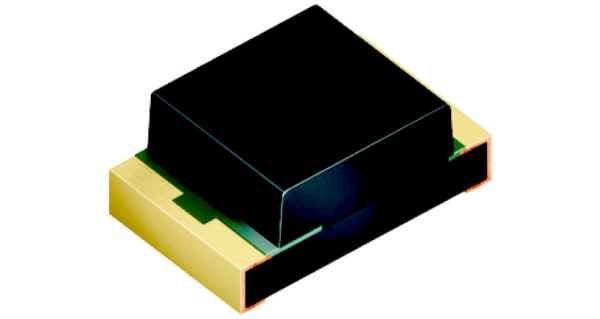
The SFH 5701 A01 ambient light sensor is Osram Opto Semiconductors’ latest addition to its portfolio for the automotive sector and the company’s first IC-based component for which a separate power supply pin is not required. The ambient light sensor (ALS) is an active component in which the IC is powered by the signal current and is therefore not reliant on an external power supply. It therefore has only two pins instead of three or more, making it much easier to connect and operate. The special filter encapsulation of the SFH 5701 A01 lets mainly green light through and filters out infrared wavelengths very efficiently. This ensures that the surface-mountable component is ideally adapted to the spectral sensitivity of the human eye, which also is most sensitive to light in the green range of the color spectrum. Overall, the sensor detects light in the spectrum between 450 nm and 700 nm – the visible range for the human eye.
SFH 5701 A01 is an analog component with a linear integrated amplifier which supplies a typical signal of 135 µA at 100 lux. The high dynamic range and high sensitivity at low illuminance of 0.01 lux combine to produce reliable light measurements for a wide range of ambient light conditions. The ALS delivers precise measurements even behind dark glass or plastic covers – a major benefit for passenger cell designs. Its footprint of 1.25 mm x 2.0 mm x 0.8 mm also means it is extremely compact. Integrated thermal compensation makes the component insensitive to fluctuations in temperature.
Read more: Osram’s SFH 5701 Ambient Light Sensor (ALS)
- How does the SFH 5701 A01 receive power?
The IC is powered by the signal current so it does not require a separate external power supply pin. - What makes this sensor ideal for the human eye?
Its special filter encapsulation lets mainly green light through and filters out infrared wavelengths efficiently. - Does the sensor work behind dark glass or plastic?
Yes, it delivers precise measurements even behind dark glass or plastic covers. - What is the detection spectrum of the SFH 5701 A01?
The sensor detects light in the spectrum between 450 nm and 700 nm which is the visible range for the human eye. - Can the sensor handle temperature fluctuations?
Integrated thermal compensation makes the component insensitive to fluctuations in temperature. - What is the typical signal output at 100 lux?
The linear integrated amplifier supplies a typical signal of 135 µA at 100 lux. - How many pins does this component have compared to others?
It has only two pins instead of three or more because it lacks a separate power supply pin. - Is this sensor suitable for the automotive sector?
Yes, it is Osram Opto Semiconductors’ latest addition specifically for the automotive sector.
