
Summary of NEW TQ MODULE BASED ON ARM® CORTEX®-A53 WITH I.MX8M MINI AND NANO TECHNOLOGY
TQ introduces the TQMa8MxML LGA embedded module supporting all nine CPU variants of NXP’s i.MX8M Mini and Nano families, with full signal-pin availability in every configuration. The common design covers both CPUs, offering LPDDR4 (up to 4 GB on Mini, 2 GB on Nano), optional QSPI NOR flash (up to 256 MB) alongside onboard eMMC, and supports Dual Core, Quad Lite, and Quad Core derivatives. Differences include memory interface width (32-bit Mini vs 16-bit Nano), different GPUs (GC Nano Ultra vs GC7000 Lite), and lack of hardware video encoding/decoding in the Nano. Cortex-M4 adds security features.
Parts used in the TQMa8MxML:
- i.MX8M Mini CPU (various derivatives)
- i.MX8M Nano CPU (various derivatives)
- LPDDR4 RAM (up to 4 GB for Mini, up to 2 GB for Nano)
- eMMC flash memory (included)
- Optional QSPI NOR flash (up to 256 MB)
- LGA module package (TQMa8MxML)
- Integrated Cortex-M4 processor
- GC Nano Ultra GPU (on i.MX8M Mini)
- GC7000 Lite GPU (on i.MX8M Nano)
The technology company TQ is expanding its i.MX8 product range with the new embedded module TQMa8MxML based on the i.MX8M Mini and Nano CPU family. It supports all nine CPU derivatives of the two families on the small LGA module and all signal pins are available in every configuration.
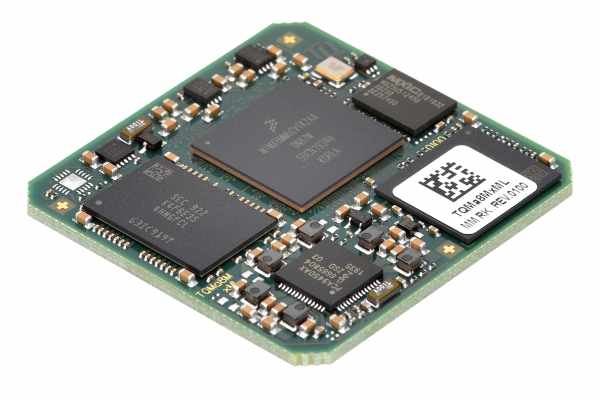
The i.MX8M Mini and Nano CPUs from NXP stand out within the i.MX8M family in that they are less expensive due to optimized features. TQ has decided to provide users with 100 percent of the signal pins in the form of an LGA module for the module design of the TQMa8MxML. In doing so, TQ has managed to combine the requirements of both CPUs in a common design. This allows users to choose the optimal variant for their needs and project. The module was equipped with an LPDDR4 with up to 4 GB on the i.MX8M Mini and 2 GB on the i.MX8M Nano. In addition, a QSPI NOR flash with up to 256 MB is available as an option to the included eMMC flash memory.
The i.MX8M Mini differs from the i.MX8 Nano in particular by its 32-bit wide memory interface compared to the 16-bit of the Nano. The Mini uses GC Nano Ultra as GPU, while the GC7000 Lite runs on the Nano. In addition, to reduce costs, the Nano does not have hardware support for video decoding and encoding
Both pin-compatible product families offer nine CPU variants (Dual Core, Quad Lite and Quad Core) with different expansion stages. The CPU-integrated Cortex-M4 processor supports numerous security functions.
Read more: NEW TQ MODULE BASED ON ARM® CORTEX®-A53 WITH I.MX8M MINI AND NANO TECHNOLOGY
- What CPUs does the TQMa8MxML support?
It supports all nine CPU derivatives of the i.MX8M Mini and i.MX8M Nano families. - Are all signal pins available on the module in every configuration?
Yes, TQ provides 100 percent of the signal pins in every configuration on the LGA module. - What memory options are available on the TQMa8MxML?
The module includes eMMC flash memory, LPDDR4 RAM (up to 4 GB for Mini, up to 2 GB for Nano), and an optional QSPI NOR flash up to 256 MB. - What is the difference in memory interface between Mini and Nano?
The i.MX8M Mini uses a 32-bit wide memory interface, while the i.MX8M Nano uses a 16-bit interface. - Which GPUs are used on the Mini and Nano variants?
The Mini uses the GC Nano Ultra GPU, while the Nano uses the GC7000 Lite GPU. - Does the i.MX8M Nano support hardware video decoding and encoding?
No, the Nano does not have hardware support for video decoding and encoding to reduce costs. - What CPU core configurations are available in these families?
Both families offer Dual Core, Quad Lite, and Quad Core variants. - Does the module include any security-related processor?
Yes, the CPU-integrated Cortex-M4 processor supports numerous security functions.
