
Summary of MIROMICO’S FMLR-6X-X-MA62X, THE “WORLD’S SMALLEST” LORAWAN MODULE
Miromico AG unveiled the FMLR-6x-x-MA62x, claiming it is the world's smallest LoRaWAN module with an integrated Arm Cortex-M4 microcontroller. Built around the Maxim MAX23625/26, this 8.6mm by 9.3mm device supports long-range wireless connectivity up to 50km using Semtech SX1261/SX1262 transceivers. It features extensive memory, ultra-low power consumption modes, and supports various modulation schemes including (G)FSK and ASK. The module includes open-source software stacks and allows for firmware updates via SWD, UART, or OTA. A daughterboard is available for prototyping, adding antenna connectors and sensors.
Parts used in the FMLR-6x-x-MA62x Module:
- Maxim MAX23625/26 microcontroller
- Semtech SX1261 wireless transceiver
- Semtech SX1262 wireless transceiver
- Hirose U.FL antenna connector
- External flash storage
- Extra sensors
- Daughterboard
Miromico AG has developed a LoRaWAN module with integrated Arm Cortex-M4 microcontroller, which was unveiled at Embedded World 2020. They claim it is the world’s smallest LoRaWAN module with integrated Arm Cortex-M4 microcontroller. Also referred to as the FMLR-6x-x-MA62x Module, Miromico module’s latest design is built around the Maxim MAX23625/26 microcontroller, which enables an Arm Cortex-M4, clocking at up to 96MHz from the internal oscillator of as low as 4MHz from a low-power system clock.
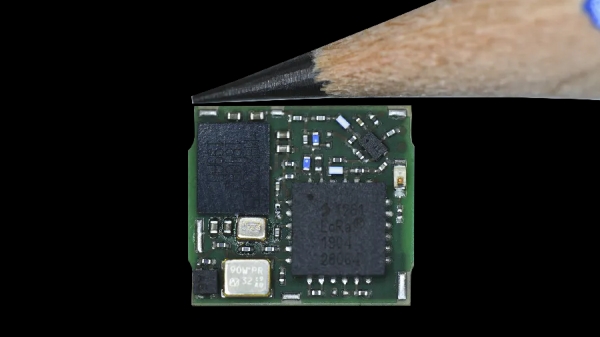
The LoRa® FMLR RF modules enable wireless connectivity to almost all devices, systems and sensors communicating at low data rate over a distance of more than 50km. It is equipped with the latest software “LoRa Basics™ MAC”. Power consumption of the underlying nodes can be optimized to run from a small-sized battery, while the integrated radio allows the system to operate in a duty-cycled manner. It also offers 512kB of flash memory, 160kB of static RAM, 9kB of instruction cache, and extremely low power operation, which goes as low as 49µA/MHz when executing from flash and 2.56µW in data-retaining sleep mode. The module features wireless connectivity, which is enabled via a Semtech SX1261 or SX1262 wireless transceiver, offering full support for the increasingly popular LoRaWAN low-power long-range wide area network protocol with up to 20dBm transmission and -137dBm receive sensitivity.
In order to enable backward-compatible upgrade paths for grown products and systems, the FMLR family supports additional modulation schemes over LoRa. These modulation schemes include (G)FSK, (G)MSK, ASK, and OOK. Highly configurable OTA packet formats enable the communication with standards like Wireless Mbus and IEEE802.15.4g. The modules also allow the emulation of proprietary systems such as Nordic NRF905 or NRF9E5 with enhanced coverage range. For fast prototyping and development, the proprietary firmware including the wireless stack can be updated via SWD, UART-Bootloader, or OTA. Measuring 8.6mm by 9.3mm (around 0.34″ by 0.37″) in size, Miromico claims the module as “to the best of our knowledge the smallest LoRaWAN module ever produced.” For it to be easy to use during the prototyping stages, a daughterboard is available, which adds a Hirose U.FL antenna connector, additional external flash storage, and extra sensors. The LoRaWAN software stack is available as an open source solution which runs on the integrated microcontroller.
Read more: MIROMICO’S FMLR-6X-X-MA62X, THE “WORLD’S SMALLEST” LORAWAN MODULE
- What is the size of the Miromico LoRaWAN module?
The module measures 8.6mm by 9.3mm. - How far can the LoRa FMLR RF modules communicate?
They enable communication over a distance of more than 50km. - Does the module support multiple modulation schemes?
Yes, it supports (G)FSK, (G)MSK, ASK, and OOK. - Can the firmware be updated wirelessly?
Yes, the proprietary firmware can be updated via OTA. - What is the receive sensitivity of the module?
The module offers -137dBm receive sensitivity. - Is there a daughterboard available for prototyping?
Yes, a daughterboard is available that adds an antenna connector and extra sensors. - What is the power consumption in data-retaining sleep mode?
The power consumption goes as low as 2.56µW in data-retaining sleep mode. - Does the module run on an open source software stack?
Yes, the LoRaWAN software stack is available as an open source solution.
