
Summary of STO1000E 150MHZ BATTERY-POWERED PORTABLE OSCILLOSCOPES
Micsig's STO1000E PLUS series introduces portable, battery-powered oscilloscopes with up to 150MHz bandwidth and 70Mpts memory. These tablet-style instruments feature an 8-inch touchscreen, 1GSa/s sampling, and a 7.5Ah Li battery for field use. They support advanced triggering, serial protocol decoding, and remote control via WiFi or LAN. The package includes passive probes, a power adapter, and built-in HDMI output for demonstrations.
Parts used in the STO1000E PLUS Oscilloscope:
- STO1102E PLUS 2-channel 100MHz oscilloscope
- STO1152E PLUS 150MHz 2-channel oscilloscope
- STO1104E PLUS 4-channel 100MHz oscilloscope
- 8 inch touch screen display
- 7.5Ah Li battery
- Two P130A 200MHz x10 passive probes
- External 12V power adapter
- Built-in prop stand
Micsig’s STO1000E 2/4-channel oscilloscopes include 70Mpts memory, 1GSa/s sampling, 130,000wfm/s refresh rate, and a 7.5Ah Li battery for extended field use.
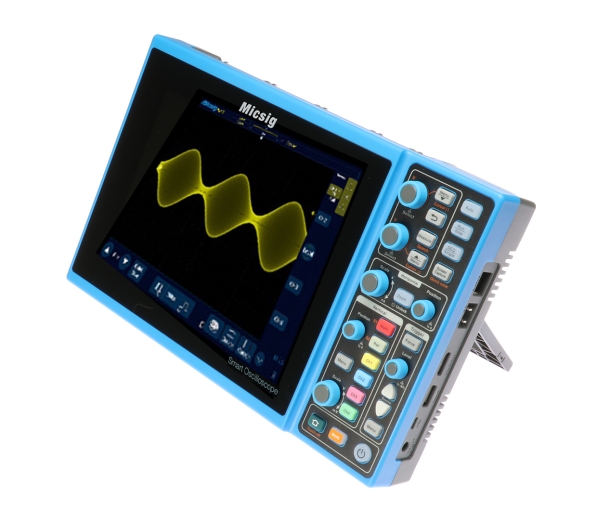
Saelig Company, Inc. has introduced the Micsig STO1000E PLUS series of two- and four-channel battery-powered portable oscilloscopes, which offer bandwidths of up to 150MHz. The three models in the series are: STO1102E PLUS 2-channel 100MHz, STO1152E PLUS 150MHz 2-channel, and STO1104E PLUS 4-channel 100MHz. Each oscilloscope includes 70Mpts memory, 1GSa/s sampling (single channel), 130,000wfm/s refresh rate, and a 7.5Ah Li battery for extended field use.
These innovative portable instruments are a development of Micsig’s range of tablet oscilloscopes and combine an 8” touch screen (touch, drag, and swipe) with ‘button & knob’ operation. An external USB mouse can also be connected for additional control choices, with an internal software pop-up keyboard provided for data entry. The built-in HDMI output adds educational and demonstration possibilities, and an auto-calibration function ensures measurement accuracy. Sophisticated waveform triggering techniques include: Edge, Pulse Width, Logic, Video, Runt, Time Out , Nth Edge, Slopetime, and Serial Decode. A screen capture button provides a quick way of saving waveform images for later review or report writing.
Included as standard are two P130A 200MHz x10 passive probes and an external 12V power adapter. STO1000E PLUS oscilloscopes can make 31 types of automatic measurements, and decode a selection of serial protocols, including UART, CAN, LIN, SPI, I2C, 1553B, and ARINC429. I/O provisions include Wi-Fi, LAN, HDMI, USB Host, USB Device, DC Power, and Aux out. 8GB of internal data storage is included for data files that can be transferred to a PC via a USB connection, LAN, or WiFi.
The oscilloscope features a built-in prop stand for easy viewing. When the oscilloscope is connected to a LAN or WiFi network, live screen images can be transmitted to an external projector. The scope can also be remotely PC-controlled via WiFi, LAN, or USB, and also via an Android mobile device.
Read more: STO1000E 150MHZ BATTERY-POWERED PORTABLE OSCILLOSCOPES
- What are the available bandwidth options for the STO1000E PLUS series?
The series offers three models with bandwidths of 100MHz and 150MHz. - How long does the battery last during extended field use?
The device is equipped with a 7.5Ah Li battery designed for extended operation. - Can I connect an external mouse to the oscilloscope?
Yes, an external USB mouse can be connected for additional control choices. - Which serial protocols can the scope decode?
It decodes UART, CAN, LIN, SPI, I2C, 1553B, and ARINC429. - Does the oscilloscope have a built-in screen for presentations?
Yes, it features an 8 inch touch screen with an internal software pop-up keyboard. - How can I transfer data files from the device to a PC?
Data stored in the 8GB internal memory can be transferred via USB connection, LAN, or WiFi. - Is remote control of the oscilloscope possible?
Yes, the scope can be remotely controlled via WiFi, LAN, USB, or an Android mobile device. - What types of waveform triggering techniques are supported?
Supported techniques include Edge, Pulse Width, Logic, Video, Runt, Time Out, Nth Edge, Slopetime, and Serial Decode.
