
Summary of LINUX-DRIVEN PICOCORE™MX8MN MODULE IS TINY
F&S Elektronik Systeme developed the PicoCore™MX8MN, a compact 35x40mm CPU module based on the NXP i.MX 8M Nano processor. It features a heterogeneous multi-core architecture with four Cortex-A53 cores and one Cortex-M7 for real-time tasks. The module supports extensive industrial interfaces including Ethernet, CAN-FD, USB, SDIO, I2C, SPI, UART, audio, GPIOs, PWM, MIPI-CSI, MIPI-DSI, and LVDS. It offers up to 8GB RAM, optional WLAN/BT, and robust security features like Secure Boot and an A71CH chip. F&S provides full Linux support with Buildroot/Yocto, FreeRTOS for the M7 core, and pre-tested drivers for various displays and touch controllers.
Parts used in the PicoCore™MX8MN:
- NXP i.MX 8M Nano applications processor
- Arm Cortex-A53 cores (up to four)
- Cortex-M7 core
- Up to 8GB RAM
- 512MB SLC NAND Flash or 32GB eMMC
- NOR Flash for device parameters
- NXP A71CH Plug-&-Trust-Secure-Element
- Optional WLAN/BT5.0 LE module
- MIPI-DSI interface
- LVDS interface
COM modules with NXP i.MX 8M Nano CPU High performance in a compact format
Based on the NXP® i.MX 8M Nano applications processor, F&S Elektronik Systeme has developed an inexpensive CPU module (35x40mm) with many industrial interfaces and extensive software support.
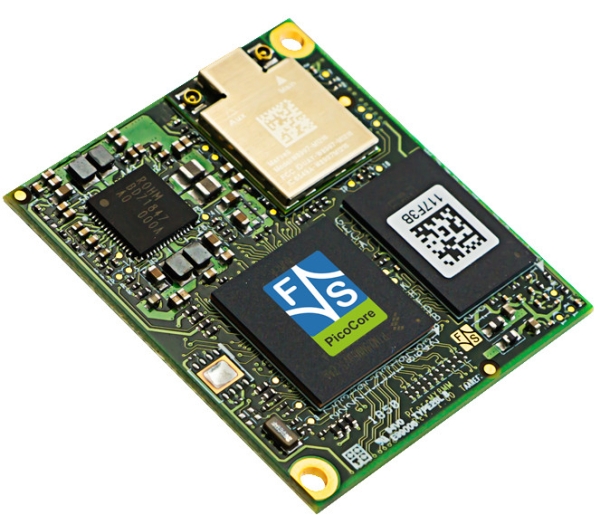
The heterogeneous multi-core processor consists of up to four Arm® Cortex®-A53 cores (1.5GHz) and an additional Cortex®-M7 for real-time processing. Up to 2x Gbit Ethernet, CAN-FD, USB, 2x SDIO, 4x I2C, 2x SPI, 4x UART, audio (Line In/ Out/ Mic/ Headphone or I2S), GPIOs, PWM and MIPI-CSI for camera connection are available. Displays can be connected either via a MIPI-DSI interface (4 lanes) or via LVDS (2 channels). The maximum resolution is FullHD. The optional WLAN/ BT5.0 LE module with antenna socket also makes portable applications possible.
The i.MX 8M Nano is equipped with OpenGL 2.1/ 3.0/ 3.1 and OpenCL 1.2, providing sufficient performance for a modern user interface.
The PicoCore™MX8MN is offered with up to 8GB RAM, 512MB SLC NAND Flash or 32GB eMMC. A small NOR Flash for storing device parameters is of course also provided.
Besides Secure Boot (protection of the system against manipulation and protection of the software against decryption), an additional security chip (NXP A71CH Plug-&-Trust-Secure-Element) offers further security for IoT connections. The programming of the certificates can be done by the customer himself, alternatively F&S Elektronik Systeme offers this as a service.
The operating system Linux® (with support for Buildroot and Yocto), was ported by the experienced software team of F&S Elektronik Systeme. For all interfaces the drivers have been adapted and tested. Different memory sizes and different displays are supported. For many touch controllers there are ready-to-use drivers. For the Cortex®-M7 an adapted FreeRTOS and various “Bare Metal” examples are available. The communication between Cortex®-M7 and Cortex®-A53 is implemented and tested. The Cortex®-M7 is able to process real-time tasks shortly after power-on.
Extensive documents explain the development on Linux side as well as on Cortex®-M7 side. With the help of the virtual machine provided for download, the development of the own application, e.g. under QT, can be started immediately.
Read more: LINUX-DRIVEN PICOCORE™MX8MN MODULE IS TINY
- What is the size of the PicoCore™MX8MN module?
The module measures 35x40mm. - How many processor cores does the i.MX 8M Nano have?
It consists of up to four Arm Cortex-A53 cores and one additional Cortex-M7 core. - Can the module connect external cameras?
Yes, it supports camera connection via a MIPI-CSI interface. - Does the module support wireless connectivity?
An optional WLAN/BT5.0 LE module with an antenna socket is available for portable applications. - What operating systems are supported on the module?
Linux is supported with options for Buildroot and Yocto, while FreeRTOS is available for the Cortex-M7 core. - How is data security handled on this module?
Security includes Secure Boot and an additional NXP A71CH Plug-&-Trust-Secure-Element chip. - What display interfaces are available?
Displays can be connected via a 4-lane MIPI-DSI interface or 2-channel LVDS, supporting up to FullHD resolution. - Is development documentation provided?
Extensive documents explain development on both the Linux side and the Cortex-M7 side.
