
Summary of IWAVE OBD II SECURED EDGE ANALYTICS ENABLING IOT IN FLEET MANAGEMENT
iWave’s OBD II secured edge analytics is an IoT fleet-management device providing real-time vehicle diagnostics, high-accuracy GNSS tracking, driving behavior analysis, and safety features. It reads DTCs, supports CAN FD and SAE J1939, Secure FOTA, and recent certifications (CE/FCC, GCF, E-Mark, KOMINFO). The system enables remote monitoring of location, speed, idling, fuel efficiency, and engine performance to improve uptime, reduce maintenance costs, and encourage safer driving.
Parts used in the OBD II secured edge analytics:
- OBD II interface device
- GNSS module (supports GPS, GLONASS, Galileo, Beidou)
- 9-axis sensor suite
- CAN FD support
- SAE J1939 protocol support
- Secure FOTA capability
- Certifications: CE/FCC
- Certifications: GCF
- Certifications: E-Mark
- Certifications: KOMINFO
Everyone desires to own a vehicle, but the business of leading a fleet of vehicles is never an easy task. From the safety of the fleet, route optimizing, trip analysis to timely maintenance, fleet owners have a lot in their hands to deal with regularly. With the ever-increasing prices of vehicles and fuel, enterprises are often under pressure to utilize fleet efficiently and optimize their useful life.
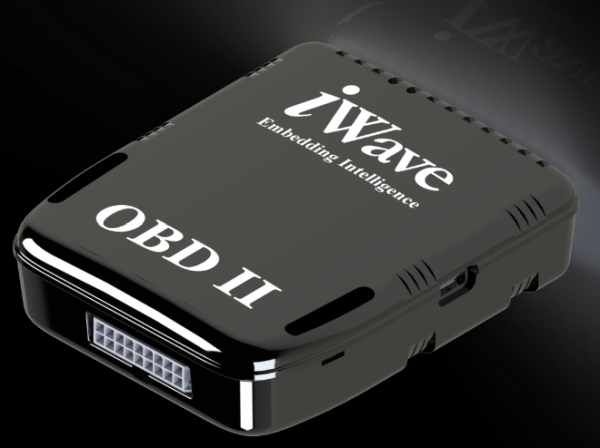
iWave presents a smart IoT solution to address all fleet management concerns and help differentiate businesses with improved administration and efficiency.
iWave’s revolutionary OBD II secured edge analytics offers an innovative way to transform traditional fleet management practices. The device provides quality real-time insights that help fleet managers make smart decisions and drive profitable outcomes for their business.
The OBD II IoT solution offers high accuracy location tracking, real-time vehicle diagnostics, driving condition analysis, and enhanced safety features that make fleet management a cakewalk. The industry winning OBD II device is now updated with CE/FCC, GCF, E-Mark, KOMINFO Certifications and supports new features such as CAN FD, SAE J1939 Protocol and Secure FOTA.
The OBD II device opens up a multitude of interesting possibilities in fleet management.
An X-ray vision into your fleet ensures vehicle uptime
The device reads diagnostics trouble codes (DTC) that can be analysed to determine vehicle parameters such as fuel efficiency, mileage and engine performance. The data can be examined to detect faults precisely and helps to implement corrective measures on time. Minor defects can be corrected in-house, thereby reducing maintenance costs and ensuring vehicle uptime.
Be in touch with your fleet anytime, anywhere.
High-accuracy location tracking facilitates complete visibility over your fleet activities. Access to up to four concurrent GNSS constellations including GPS, GLONASS, Galileo and Beidou enhances the overall tracking performance of the module. Accurate real-time insights helps remotely monitor distance, speed, time, route, idling etc. and enable optimal utilization of the fleet.
Ensure your fleet are in right hands always
Analysing driving habits helps track common practices and monitor harmful behavior. The device features an advanced 9 axis sensors support that help detect harsh driving patterns such as over speeding, hurried braking, engine revving, etc. Drivers are encouraged to follow safe driving, thereby ensuring fewer accidents on the road.
Read more: IWAVE OBD II SECURED EDGE ANALYTICS ENABLING IOT IN FLEET MANAGEMENT
- What diagnostics can the OBD II device read?
The device reads diagnostic trouble codes (DTC) to determine parameters like fuel efficiency, mileage, and engine performance. - Does the device support multiple GNSS constellations?
Yes, it supports up to four concurrent GNSS constellations: GPS, GLONASS, Galileo, and Beidou. - Can the device detect harsh driving behavior?
Yes, it features an advanced 9 axis sensors support to detect harsh driving patterns such as over speeding, hurried braking, and engine revving. - What protocols and interfaces does the device support?
It supports CAN FD and the SAE J1939 protocol along with the OBD II interface. - Does the device support remote firmware updates?
Yes, it supports Secure FOTA for remote firmware updates. - What certifications does the OBD II device have?
The device is updated with CE/FCC, GCF, E-Mark, and KOMINFO certifications. - How does the device help reduce maintenance costs?
By reading DTCs and enabling early detection of minor defects, issues can be corrected in-house, reducing maintenance costs and improving uptime. - What real-time vehicle information does the device provide?
It provides real-time insights on location, distance, speed, time, route, and idling.
