
Summary of HOW TO TIME DRONE RACES WITHOUT TRANSPONDERS
Delta 5 Race Timer uses pilots' existing video transmitters as virtual transponders to time drone laps, eliminating extra hardware on aircraft. The open-source system uses modified RX508 video receiver PCBs connected to Arduinos (SPI-enabled), which talk to a Raspberry Pi over I2C. The Pi hosts a web UI to control receivers and manage races. The design is economical, documented on GitHub, and has influenced projects like RotorHazard.
Parts used in the Delta 5 Race Timer:
- RX508 video receiver PCB (modified for SPI)
- Arduino (one per RX508 for low-level communications)
- Raspberry Pi (hosts web UI and high-level control)
- I2C connection between Arduinos and Raspberry Pi
- SPI modification/interface on RX508
- Video transmitters on each racing drone (existing equipment used as transponders)
Drone racing is nifty as heck, and a need all races share is a way to track lap times. One way to do it is to use transponders attached to each racer, and use a receiver unit of some kind to clock them as they pass by. People have rolled their own transponder designs with some success, but the next step is ditching add-on transponders entirely, and that’s exactly what the Delta 5 Race Timer project does.
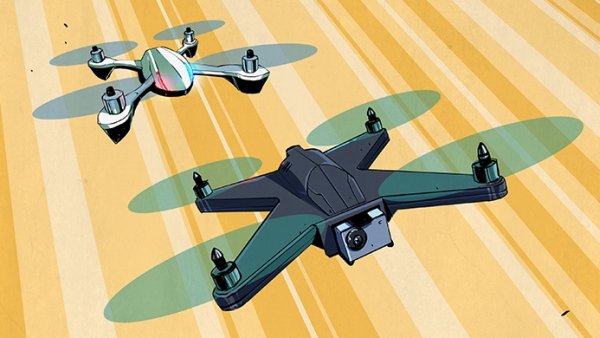
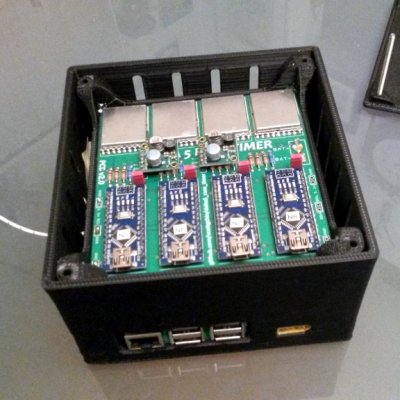
The open-sourced design has a clever approach. In drone racing, each aircraft is remotely piloted over a wireless video link. Since every drone in a race already requires a video transmitter and its own channel on which to broadcast, the idea is to use the video signal as the transponder. As a result, no external hardware needs to be added to the aircraft. The tradeoff is that using the video signal in this way is trickier than a purpose-made transponder, but the hardware to do it is economical, accessible, and the design is well documented on GitHub.
The hardware consists of RX508 video receiver PCBs modified slightly to enable them to communicate over SPI. Each RX508 is attached to its own Arduino, which takes care of low-level communications. The Arduinos are themselves connected to a Raspberry Pi over I2C, allowing the Pi high-level control over the receivers while it serves up a web-enabled user interface. As a bonus, the Pi can do much more than simply act as a fancy stopwatch. The races themselves can be entirely organized and run through the web interface. The system is useful enough that other projects using its framework have popped up, such as the RotorHazard project by [PropWashed] which uses the same hardware design.
While rolling one’s own transponders is a good solution for getting your race on, using the video transmission signal to avoid transponders entirely is super clever. The fact that it can be done with inexpensive, off the shelf hardware is just icing on the cake.
Source:HOW TO TIME DRONE RACES WITHOUT TRANSPONDERS
- How does the Delta 5 Race Timer avoid add-on transponders?
It uses each drone's existing video transmission signal as the transponder, detected by ground receivers. - What hardware does the system use to receive video signals?
Modified RX508 video receiver PCBs are used to receive the video signals. - How are the RX508 receivers connected to the rest of the system?
Each RX508 is attached to an Arduino for low-level communications and modified to communicate over SPI. - How does the Raspberry Pi interact with the Arduinos?
The Arduinos connect to the Raspberry Pi over I2C so the Pi has high-level control over the receivers. - Can races be managed through the system interface?
Yes, the Raspberry Pi serves a web-enabled user interface that can organize and run races. - Is the design open source and documented?
Yes, the design is open-sourced and well documented on GitHub. - Is additional hardware required on the drones themselves?
No additional transponder hardware is required because the system uses the drones' existing video transmitters. - Has this design influenced other projects?
Yes, projects like RotorHazard by PropWashed have used the same hardware design.
