
Summary of DETECTING ALGAL BLOOMS WITH THE HELP OF AI
Harmful algal blooms detection system uses a boroscope to image deep blooms, a Raspberry Pi 4 running a machine learning model trained on those images to recognize blooms, and an Arduino Nano collecting pH, TDS, and water temperature data. When a bloom is detected, the system can send WhatsApp alerts so users can take action.
Parts used in the AI-assisted algal bloom detector:
- Boroscope (for deep-water imaging)
- Raspberry Pi 4
- Machine learning model (trained on boroscope images)
- Arduino Nano
- pH sensor
- TDS (total dissolved solids) sensor
- Water temperature sensor
- Serial connection between Arduino Nano and Raspberry Pi
- WhatsApp notification integration
Harmful Algal Blooms (HABs) can have negative consequences for both marine life and human health, so it can be helpful to have early warning of when they’re on the way. Algal blooms deep below the surface can be especially difficult to detect, which is why [kutluhan_aktar] built an AI-assisted algal bloom detector.
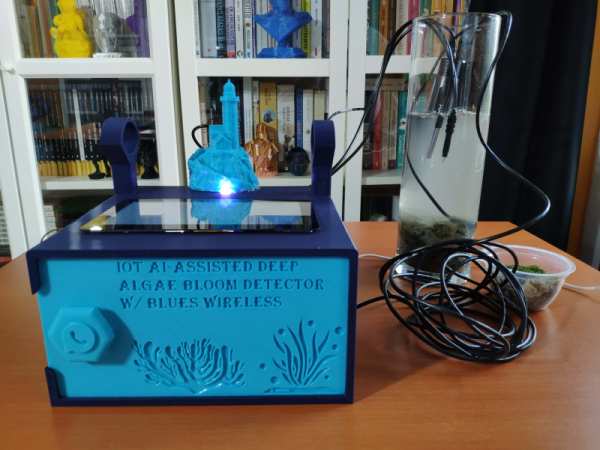
After taking images of deep algal blooms with a boroscope, [kutluhan_aktar] trained a machine learning algorithm on them so a Raspberry Pi 4 could recognize future occurrences. For additional water quality information, the device also has an Arduino Nano connected to pH, TDS (total dissolved solids), and water temperature sensors which then are fed to the Pi via a serial connection. Once a potential bloom is spotted, the user can be notified via WhatsApp and appropriate measures taken.
If you’re looking for more environmental sensing hacks, check out the OpenCTD, this swarm of autonomous boats, or this drone buoy riding the Gulf Stream.
Source: DETECTING ALGAL BLOOMS WITH THE HELP OF AI
- What imaging tool is used to capture deep algal blooms?
A boroscope is used to take images of deep algal blooms. - What runs the machine learning algorithm for detection?
A Raspberry Pi 4 runs the trained machine learning algorithm to recognize blooms. - How are water quality measurements collected?
An Arduino Nano is connected to pH, TDS, and water temperature sensors to collect water quality data. - How does the Arduino Nano communicate sensor data to the Pi?
The Arduino Nano feeds sensor data to the Raspberry Pi via a serial connection. - What happens when a potential bloom is detected?
The user can be notified via WhatsApp when a potential bloom is spotted. - What additional data complements the image-based detection?
pH, total dissolved solids (TDS), and water temperature readings complement the image-based detection. - Was machine learning trained on images from this project?
Yes, the machine learning algorithm was trained on boroscope images of deep algal blooms. - Can this system help with early warning of HABs?
Yes, the system provides early warning by recognizing blooms and sending alerts so appropriate measures can be taken.
