
Summary of ARDUINO LIBRARY BRINGS RTL_433 TO THE ESP32
Summary: The rtl_433_ESP Arduino library ports much of rtl_433 to run on ESP32 microcontrollers with CC1101 or SX127X transceiver modules, enabling decoding of many ISM-band devices without an RTL-SDR dongle and computer. It supports boards like the LILYGO LoRa32 V2 (OLED, microSD), decodes fewer than half of rtl_433's devices, and has been integrated into OpenMQTTGateway to publish sensor data via MQTT for home automation.
Parts used in the rtl_433_ESP Project:
- ESP32 microcontroller
- CC1101 transceiver module
- SX127X transceiver module
- LILYGO LoRa32 V2 board (includes OLED display and microSD slot)
- rtl_433_ESP Arduino library (software)
- OpenMQTTGateway (optional integration for MQTT)
If you have an RTL-SDR compatible radio there’s an excellent chance you’ve heard of the rtl_433 project, which lets you receive and decode signals from an ever-expanding list of supported devices in the ISM radio bands. It’s an incredibly useful piece of software, but the fact that it requires an external software defined radio and a full-fledged computer to run dictated the sort of projects it could realistically be used for.
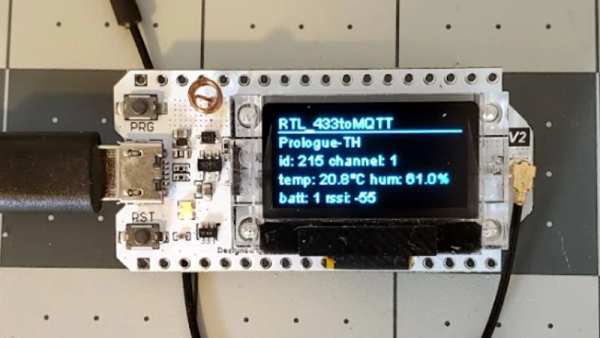
But thanks to the rtl_433_ESP Arduino library developed by [NorthernMan54], we’re now able to pack that functionality into a much smaller package. All you need is an ESP32 microcontroller and a CC1101 or SX127X transceiver module. If you’re looking for a turn-key hardware platform, the documentation notes the LILYGO LoRa32 V2 board includes the required hardware, plus adds a handy OLED display and microSD slot. It should be noted that the range of these radios don’t compare particularly well to a full-size RTL-SDR device, but that probably won’t come as much of a surprise.
The library ports a large chunk of the rtl_433 project’s code over to the smaller and less powerful platform, which [NorthernMan54] has helpfully documented by listing the source files which were brought over verbatim as well as the ones that needed some extra attention.
As you might expect, some concessions had to be made in the effort: assuming the documentation is up-to-date, the rtl_433_ESP library can decode less than half of the devices supported by rtl_433 proper. But again, considering the vast differences in capability between the hardware the project was originally designed for and a microcontroller that costs a few bucks, it’s hard to complain.
We were tipped off to this project by [1technophile], who tells us he’s integrated the rtl_433_ESP library into his OpenMQTTGateway project. This gives the microcontroller the ability to scoop up data from wireless sensors from all over the home and publish the resulting data via MQTT so it can be picked up by Home Assistant, OpenHAB, or whatever automation package you’ve got running. It’s a trick we’ve seen done before with an RTL-SDR dongle and a computer, but being able to accomplish the same task on a smaller and more energy efficient platform certainly sounds like progress to us.
Source: ARDUINO LIBRARY BRINGS RTL_433 TO THE ESP32
- Can rtl_433 functionality run on an ESP32?
Yes; the rtl_433_ESP Arduino library ports much of rtl_433 to run on ESP32 microcontrollers. - What radio modules are compatible with rtl_433_ESP?
The library works with CC1101 and SX127X transceiver modules. - Does rtl_433_ESP require an external RTL-SDR dongle?
No; it uses the ESP32 plus a CC1101 or SX127X module instead of an RTL-SDR dongle and full computer. - Is the decoding capability identical to rtl_433 on a computer?
No; the library can decode less than half of the devices supported by rtl_433 proper. - Does the LILYGO LoRa32 V2 board work with rtl_433_ESP?
Yes; the documentation notes the LILYGO LoRa32 V2 includes the required hardware and adds an OLED display and microSD slot. - Can rtl_433_ESP be used with home automation systems?
Yes; it has been integrated into OpenMQTTGateway to publish sensor data via MQTT for Home Assistant, OpenHAB, and similar systems. - Are the radio ranges comparable to a full-size RTL-SDR?
No; the range of these transceiver modules does not compare particularly well to a full-size RTL-SDR device. - Was much of the original rtl_433 code reused?
Yes; the library ports a large chunk of rtl_433 code and documents which source files were brought over verbatim versus modified.
