
Summary of CPU BUILT FROM DISCRETE TRANSISTORS
This article describes a DIY 11-bit CPU built from over 2,000 discrete transistors by Reddit user Weekly_Salamander_78, with an online interactive guide detailing logic gates, ALU, adders, memory, clocks, and more. The design uses an Arduino for memory and can run a Hello, World! program and a simple dinosaur game, showcasing a ground-up transistor-based computer.
Parts used in the Transistor Computer:
- Individual transistors (over 2,000)
- Silicon wafer (mentioned as context for ICs)
- Arduino (used for memory)
- Supporting wiring and interconnects
- Passive components for logic gate implementation (resistors, capacitors as implied)
- Clock circuitry components
- Power supply
- Input/output interfaces for running programs
We all know, at least intellectually, that our computers are all built with lots of tiny transistors. But beyond that it’s a little hard to describe. They’re printed on a silicon wafer somehow, and since any sufficiently advanced technology is indistinguishable from magic, they miraculously create a large part of modern society. Even most computers from 40 or 50 years ago were built around various inscrutable integrated circuits. On the other hand, this computer goes all the way back to first principles and implements a complete processor out of individual transistors instead.
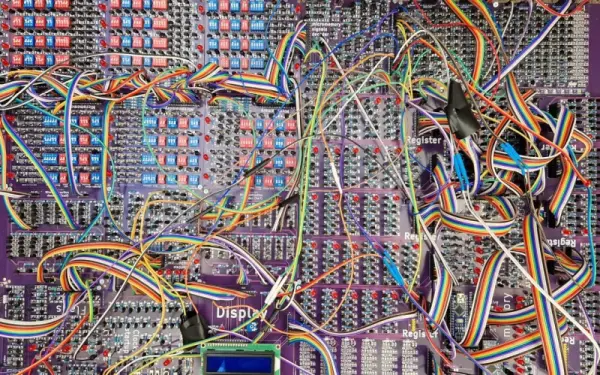
The transistor computer uses over 2000 individual transistors to implement everything comprising the 11-bit CPU. The creator, Reddit user [ Weekly_Salamander_78] also has an online interactive book that walks through each of the steps that is required to get to the point of having a working computer like this. Starting with a guide on building logic gates from transistors it will eventually cover the arithmetic logic unit, adders, memory, clocks, and everything else that is needed for the complete CPU to get up and running. The design does rely on an Arduino for memory to simplify some things, and in the end it’s able to run a Hello, World! program and play a simple dinosaur game as well.
Building a computer out of discrete components like this is an impressive accomplishment, although we might not envy the creator of it when it comes time for troubleshooting or maintenance of all of those individual components. Presumably it would be much easier to work on than something like a relay computer, but for now we’ll all take a moment to be thankful that almost no one needs to work on debugging vacuum tube computers anymore.
Source: CPU BUILT FROM DISCRETE TRANSISTORS
- What is the CPU size of the transistor computer?
The CPU is an 11-bit CPU. - How many transistors does the project use?
It uses over 2,000 individual transistors. - Does the design use integrated circuits for memory?
No, the design relies on an Arduino for memory to simplify some things. - Can the transistor computer run programs?
Yes, it can run a Hello, World! program and play a simple dinosaur game. - What parts of the CPU does the online guide cover?
The guide covers building logic gates from transistors, the ALU, adders, memory, clocks, and everything needed for the complete CPU. - Who created the transistor computer project?
The creator is Reddit user Weekly_Salamander_78. - Is building a transistor computer easier than a relay or vacuum tube computer?
The article suggests it is presumably easier to work on than a relay or vacuum tube computer.
