
Summary of Can You ID This? ID-20 RFID Reader + Arduino
This article explains how to integrate an Innovations ID series RFID reader with an Arduino for serial command control. It details the differences between ID-2, ID-12, and ID-20 models, noting they share pinouts but vary in antenna size. The guide covers hardware setup, including the need for a breadboard adapter due to pin spacing, and describes software logic to detect tag presence by toggling the reset pin rather than relying on standard single-scan behavior.
Parts used in the ID-20 RFID Reader + Arduino Project:
- Innovations ID series RFID reader (ID-2, ID-12, or ID-20)
- Arduino microcontroller
- 125kHz RFID tags
- Breadboard adapter board (optional)
- LED or buzzer (optional)
A few weeks ago we showed you how to control your arduino over serial. Well this week are going to do the same thing. Only this time instead of using the serial monitor to send the commands, we will be using the Innovations ID line RFID reader.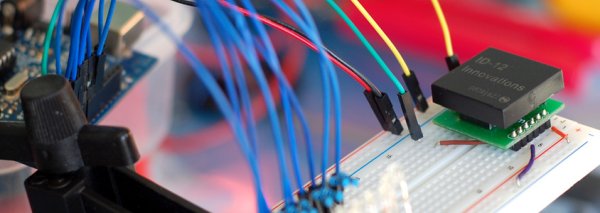
RFID, or Radio Frequency Identification, is basically a wireless barcode, and in this implementation works by a reader sending out a signal that powers a “tag”, the RFID tag then responds with a unique 12 digit hex serial number. Because each tag sends back a unique number, it can be used as a semi-secure key system, or used to track individual objects.
The company Innovations, while they may have one of the worst sites I have seen in a while, makes some really easy-to-use and inexpensive RFID readers that are easily incorporated into your microcontroller project. The Innovations ID series of RFID readers come in 3 versions, the ID-2, ID-12, and ID-20. All 3 versions have the same pinout and work exactly the same. They all operate with common 125kHz Tags. In fact, the only difference is the antenna. The 2, has no antenna and requires an external one to work, the 12, a smaller antenna, and the 20, a larger antenna. While many other RFID readers offer USB connections, these require no computer to operate and simply send their data via 9600 baud serial which is easily read by your Arduino.
Operation
Hooking this guy is pretty simple, but note that the pins on these readers are not spaced properly for use with breadboard. Sparkfun does sell a board that will give you the .1in spacing needed to work with breadboard. If you do use the adapter board, just note that it changes the placement/ orientation of the pins, so it won’t match the look of the illustration.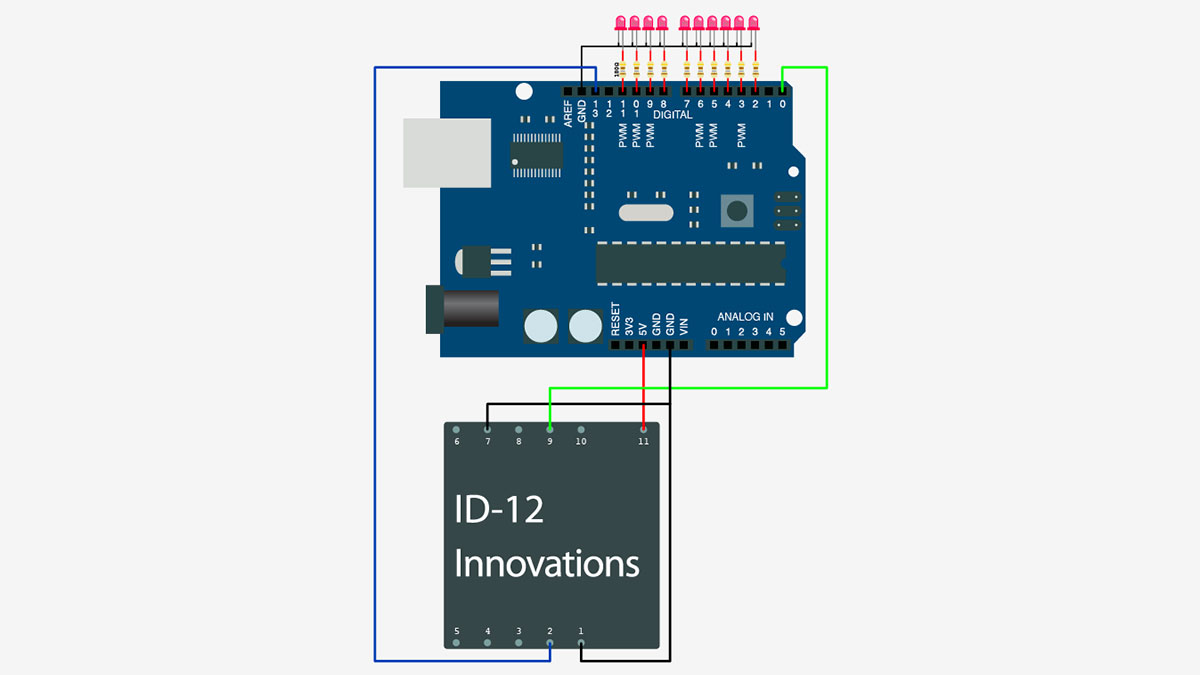
The readers also support connecting an LED or buzzer that will light/buzz when a tag is read (pin 10).
Sensing Tag Presence
With the way the reader is hooked up in the product’s spec sheet, the reader will only scan a tag once, and will not rescan until the tag is moved out of, then back into range (watch the video below). But a lot of what I do with these requires knowing when a tag is present, not just when it was scanned. We can detect tag presence by connecting the reset pin (2) to the Arduino. Taking the reset pin LOW, then HIGH for at least 150ms will force the reader to rescan and re-post if a tag is present. So you can set a timer for 250ms, or so, and if the tag is not scanned during that time, you know the tag has been removed.
For more detail: Can You ID This? ID-20 RFID Reader + Arduino
- How do the different versions of the Innovations ID reader differ?
The only difference is the antenna; the ID-2 requires an external one, while the ID-12 and ID-20 have smaller and larger built-in antennas respectively. - Can these RFID readers operate without a computer?
Yes, they require no computer to operate and send data via 9600 baud serial directly to the Arduino. - Why might I need a breadboard adapter board?
The pins on these readers are not spaced properly for use with a standard breadboard. - What happens if I connect an LED or buzzer to pin 10?
The LED will light up or the buzzer will buzz when a tag is read. - How can I detect when a tag is present continuously?
You can detect tag presence by connecting the reset pin to the Arduino and toggling it LOW then HIGH for at least 150ms. - What baud rate does the reader use for serial communication?
The reader operates at 9600 baud serial. - Do all three versions of the reader support the same tags?
Yes, all three versions work exactly the same and operate with common 125kHz Tags.
