
Summary of Arduino Portenta H7 Lite Connected development board launched
The Arduino Portenta H7 Lite Connected is a cost-optimized development board designed for AI applications and low-latency control. It features a dual-core STM32H747 processor (Cortex M7 and M4) with integrated WiFi and Bluetooth connectivity. By removing the high-resolution video interface, this board offers powerful edge computing capabilities at an accessible price point of €82, making it ideal for robotics and connected prototyping without the need for full-fledged video support.
Parts used in the Portenta H7 Lite Connected:
- STM32H747 dual core processor
- Cortex M7 running at 480 MHz
- Cortex M4 running at 240 MHz
- Onboard wireless module (WiFi and Bluetooth)
- Secure element for certificates storage
- Two 80-pin high-density connectors
- Micropython programming language support
The official Arduino team have introduced a new development board to their range this week in the form of the Portenta H7 Lite Connected which is now available to purchase priced at €82. The Portenta H7 Lite Connected is designed to provide the computational power of the Portenta H7 for AI applications and low-latency control solutions. The small yet powerful board is equipped with a module that is made more cost-effective by removing the high-resolution video interface feature.
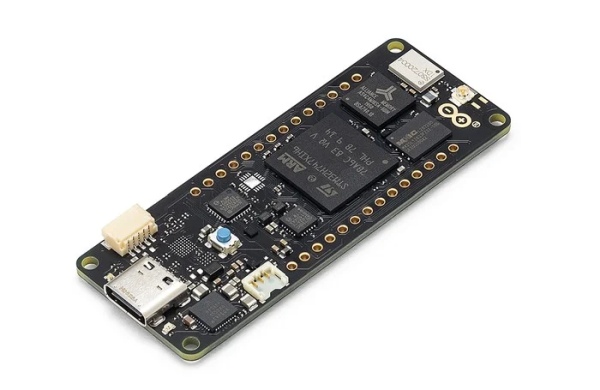
Benefits of the Portenta H7 Lite Connected board include : Dual Core – Two best-in-class processors in one, running parallel tasks AI on the edge powerful enough to run AI state machines, Onboard wireless module capable of simultaneously managing WiFi and Bluetooth connectivity, High-level programming language support (Micropython) and onboard secure element for certificates storage and management.
ArduinoPortenta H7 Lite Connected
The Portenta H7 Lite Connected’s main processor is the STM32H747 dual core including a Cortex M7 running at 480 MHz and a Cortex M4 running at 240 MHz. The two cores communicate via a Remote Procedure Call mechanism that allows calling functions on the other processor seamlessly. The Portenta family adds two 80-pin high-density connectors at the bottom of the module.
The Portenta H7 Lite Connected is powerful, with integrated wireless connectivity, yet remains cost-optimized. You could think of it as the H7 with only one secure element and no high-resolution video interface. Or if you prefer, the H7 Lite with the ability to connect. Here’s where the Portenta H7 Lite Connected fits into the Arduino ecosystem. – If you need excellent computational power to deploy AI on the edge. – You’re building a solution that will interact with other robotics systems, and therefore does not require a high-resolution video interface. – Prototyping an idea that you know will need to connect to WiFi but is still not at the stage where you want to invest in a fully-fledged Portenta H7.”
Source: Arduino Portenta H7 Lite Connected development board launched
- What is the primary purpose of the Portenta H7 Lite Connected?
It is designed to provide computational power for AI applications and low-latency control solutions. - How much does the Portenta H7 Lite Connected cost?
The board is priced at €82. - Does the Portenta H7 Lite Connected support wireless connectivity?
Yes, it has an onboard wireless module capable of simultaneously managing WiFi and Bluetooth connectivity. - Which processors are included in the main unit?
It includes an STM32H747 dual core featuring a Cortex M7 running at 480 MHz and a Cortex M4 running at 240 MHz. - Can I use MicroPython on this board?
Yes, the board supports high-level programming languages including Micropython. - What feature was removed to make this board more cost-effective?
The high-resolution video interface feature was removed. - How do the two cores communicate with each other?
The cores communicate via a Remote Procedure Call mechanism that allows calling functions on the other processor seamlessly. - Who should consider using this specific board over the standard Portenta H7?
Users building solutions that interact with robotics systems or prototyping ideas needing WiFi connection but not requiring a fully-fledged video interface.
