
Summary of Arduino IR Transmitter & Receiver w/ LEDs Flickering Issue
This article describes an Arduino Uno project using two IR transmitters and receivers to trigger LED patterns. The user reports random LED flickering when the IR components are connected, despite working correctly when disconnected. The issue likely stems from electrical noise or insufficient power grounding between the USB-powered Arduino and the external 12V LED supply. The author considers powering the IR sensors externally to isolate them but seeks advice on selecting the correct voltage and amperage for such a power supply.
Parts used in the Arduino IR Transmitter & Receiver w/ LEDs Flickering Project:
- Arduino Uno
- Adafruit 36mm 12V LEDs
- 12V 5A power supply
- Two IR transmitters
- Two IR receivers
- Second strand of similar LEDs (for comparison)
- USB cable
I have an Arduino Uno connected to two IR transmitters and respective receivers. Basically, when one of the receivers detects a beam break, I have a strand of LEDs display a pattern. This all works in principle, but the problem is that when the IR transmitters and receivers are connected to the Arduino, the LEDs flicker with random colors.
The specific parts I’m using:
- Adafruit 36mm 12V LEDs (http://www.adafruit.com/products/683)
- 12V 5A power supply for the LEDs (https://www.adafruit.com/products/352)
- Two IR transmitters (https://www.sparkfun.com/products/10732)
- Two IR receivers (https://www.sparkfun.com/products/10266)
Here’s a video of exactly what’s happening. At first, the IR transmitters and receivers are disconnected and everything is fine, then I connect the IR receivers and the flickering begins at around 8 seconds. http://www.youtube.com/watch?v=REAp5rODYUs. The flickering will continue even when I disconnect the IR receiver, albeit at a reduced rate.
Here’s my wiring diagram:
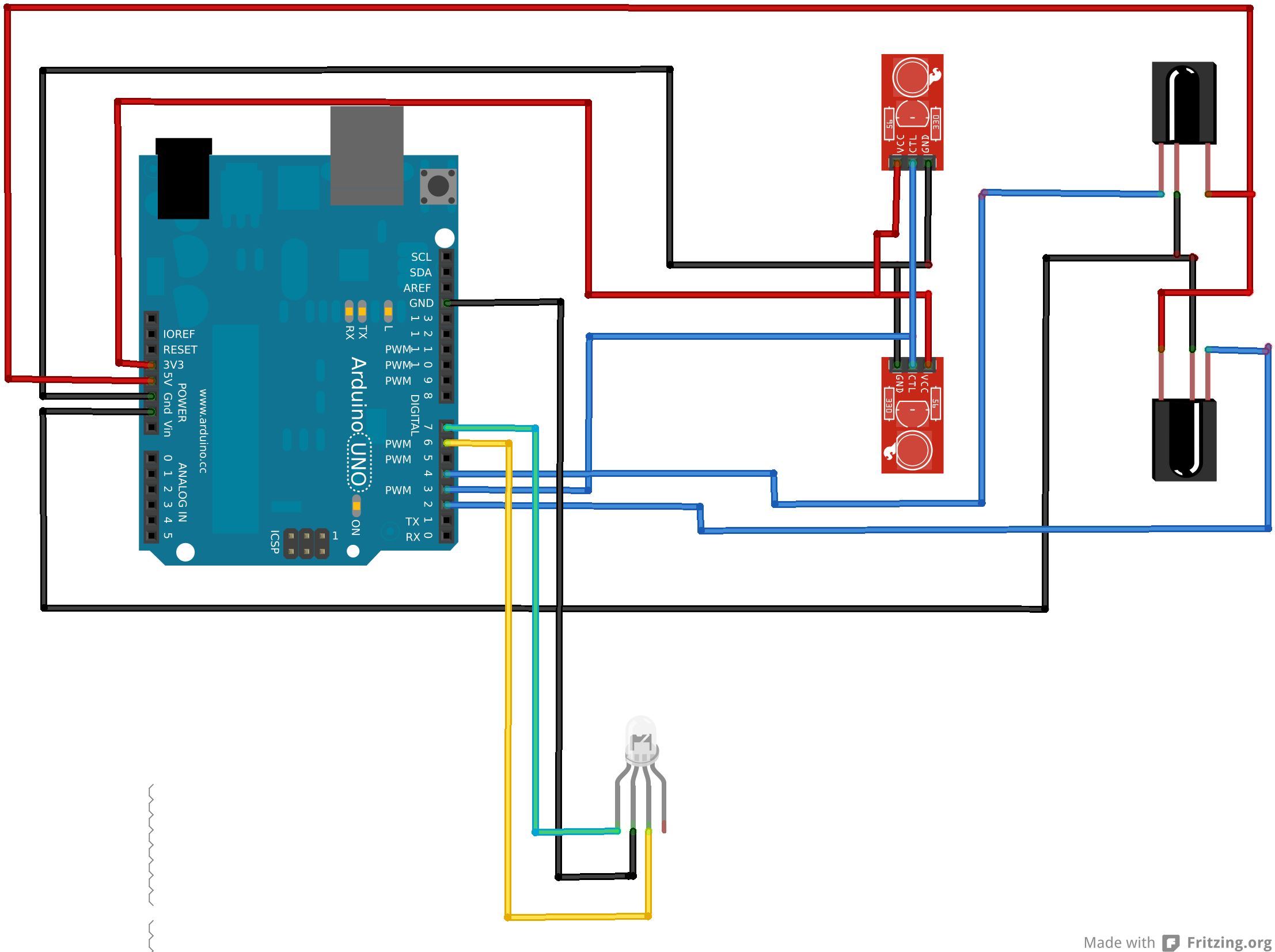
In the above diagram, the Arduino is powered via USB (I tried with a 12V power supply too), and the LED strand is powered from an external 12V power supply (I couldn’t find a diagram for an LED strand).
If it matters, I should mention that I’m using the IRremote library to control the IR transmitters (http://www.righto.com/2010/03/detecting-ir-beam-break-with-arduino-ir.html) and the strandtest example from the Adafruit WS2801 LED library (https://github.com/adafruit/Adafruit-WS2801-Library) to test everything right now.
The strange thing is that I also have another strand of similar LEDs (http://www.adafruit.com/products/322) and they do not experience the flickering regardless of if the IR transmitters and receivers are connected or not. So the only thing I can think of is to use an external power supply for the IR so as it avoid connecting them to the Arduino. Is that a valid solution? If so, how do I got about determining what power supply I would need (in terms of voltage and amperage output)?
For more detail: Arduino IR Transmitter & Receiver w/ LEDs Flickering Issue
- What happens when the IR transmitters and receivers are connected to the Arduino?
The LEDs flicker with random colors. - Does the flickering stop if the IR receiver is disconnected?
No, the flickering continues at a reduced rate even after disconnection. - Can I use an external power supply for the IR sensors to avoid connecting them to the Arduino?
Yes, this is considered a valid solution to prevent the flickering issue. - How do I determine what power supply I would need for the IR components?
You must determine the required voltage and amperage output for the specific IR parts. - What library is used to control the IR transmitters?
The IRremote library is used to control the IR transmitters. - Which example code is used to test the LED strand?
The strandtest example from the Adafruit WS2801 LED library is used. - Does the second strand of LEDs experience flickering?
No, the second strand does not experience flickering regardless of the IR connection status.
