
Summary of Arduino Battery
The author compares battery options for portable Arduino projects, evaluating AA batteries and 9V cells before selecting two series-connected 18650 Li-Ion batteries. This setup provides the necessary voltage while offering higher capacity and reusability. The article details the challenges of using unprotected cells, such as explosion risks from over-discharge, and outlines four solutions including buying protected batteries, adding individual protection circuits, purchasing dual-battery boards, or building a custom solution.
Parts used in the Arduino Battery Project:
- 6 x 18650 3200mAh Li-Ion batteries
- Two-battery holders (Black Plastic Battery Storage Case Box Holder)
- Battery charger for 18650 Rechargeable Li-Ion
- Charge-discharge protective circuit board (individual)
- Battery protection circuits designed for two batteries
- Arduino microcontroller
As many of you may know, this Lazy Old Geek loves Arduinos. Many of my projects are portable and need a battery source:
http://www.instructables.com/id/Arduino-Pedometer/
http://www.instructables.com/id/Arduino-Nokia-LCD-Sensors/
http://www.instructables.com/id/Ultrasonic-Tape-Measure/
All pricing was determined about early 2012.
So, I’ve been using Adafruit 6 AA Battery holder $5.00
https://www.adafruit.com/products/248
with 6 AA rechargeable batteries. (See Picture)
Another choice would be Adafruit 9V Battery holder $3.95
https://www.adafruit.com/products/67
My Complaint:
Here’s why I don’t like 9V alkaline batteries
Expensive ~$3
Low capacity ~600 mAh
One time use
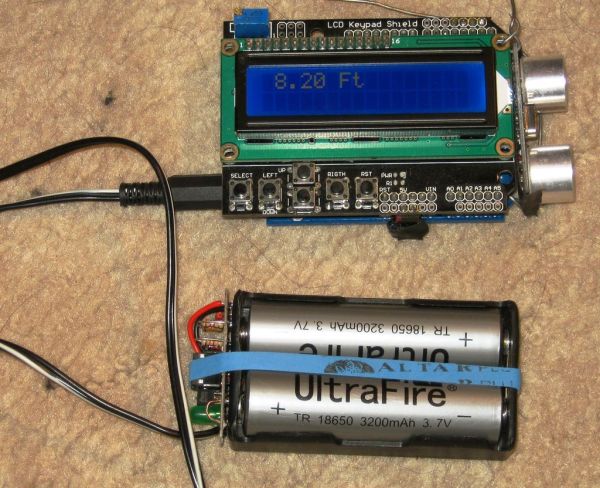
In comparison, I bought 16 AA 3000mAh NiMH rechargeable batteries for $9.38 on ebay.
6 AA rechargeables would cost $3.50 but would have 5x the capacity and are rechargeable.
My Complaint:
Okay, so I’m a Geek and I’m not really satisfied with the 6 AA battery setup.
- It’s pretty heavy and bulky.
- My battery chargers will only take four batteries at a time, so I either have to charge them in two stages or use two different chargers. But I’m Lazy.
So, naturally, I’ve been looking for an alternative.
Hark! I find out about the 18650. These are Li-Ion batteries nominally 3.7V.
Li-Ion batteries are like those used in most laptops. Now, I did some research on Li-Ion batteries and like them:
Step 1: 18650 Battery
I bought 6 18650 3200mAh batteries for $10.85 on ebay. I don’t think this is still available but you might find pricing pretty similar.
The 18650 battery is nice but it does have its own problems.
Problem: It is a little bigger than a AA battery so it needs its own holder.
Solution: You can buy a two battery holders for $1.08 on ebay. (See Picture)
Problem: It is not a standard voltage so needs its own charger.
Solution: I bought a charger for $3.46 on ebay. (See Picture)
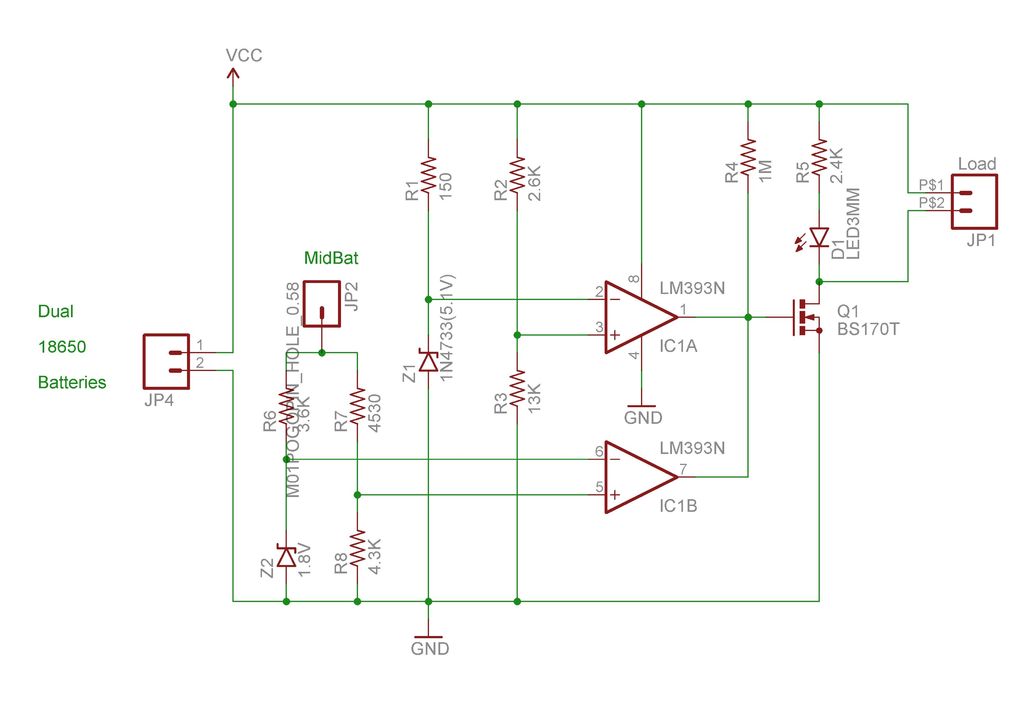
Problem: A bigger problem is that the batteries I bought are ‘unprotected.’ This is a little different from NiMH batteries which can be discharged down to about ½ a volt. If Li-Ion batteries are discharged too much they will not be rechargeable. The 18650 is nominally 3.7 volts, will charge to about 4.25 volts but should not be discharged below about 2.7 volts. I believe there are some other requirements about not charging incorrectly but I am (assuming) my charger is taking care of this. And not discharging too fast but hopefully my circuits will prevent this.
******************************************************************************************
Warning: If appropriate charge and discharge methods are not used, there apparently is some danger of the 18650 batteries exploding.
******************************************************************************************
Solution1: You can buy ‘protected’ 18650 batteries with the circuitry built in. However, they seem to be about twice the cost.
Solution2: You can buy individual battery protection circuits and add them to your batteries. I just found a protection circuit for $1.27 from Deal Extreme.
Arduino: Since I am designing a battery for the Arduino, I will need to use two 18650 batteries in series. This will provide a nominal 7.4 Vdc and up to 8.5 Vdc when fully charged. This will work fine for Arduinos with voltage regulators.
Solution3: You can buy battery protection circuits designed for two batteries. Here’s one for $4.49:
http://www.batteryjunction.com/pcb-7-2.html
Solution4: Now I am a Geek so I decided to build my own.
-
Why did the author switch from AA batteries to 18650s?
The author found 6 AA batteries too heavy and bulky, and their chargers could only handle four at a time. -
What is the main risk of using unprotected 18650 batteries?
If discharged below about 2.7 volts, they will not recharge, and improper handling can cause them to explode. -
How many 18650 batteries are needed for an Arduino with a voltage regulator?
Two batteries connected in series are required to provide a nominal 7.4 Vdc and up to 8.5 Vdc. -
What is one way to protect individual 18650 batteries?
You can buy individual battery protection circuits and add them to your batteries yourself. -
What is the cost difference between protected and unprotected 18650 batteries?
Protected 18650 batteries seem to be about twice the cost of unprotected ones. -
Why are 9V alkaline batteries considered a poor choice by the author?
They are expensive, have low capacity around 600 mAh, and are single-use items. -
What voltage should 18650 batteries not be discharged below?
They should not be discharged below about 2.7 volts to avoid becoming unrechargeable. -
Where can you find a holder specifically for two 18650 batteries?
The author found a two-battery holder on eBay for approximately $1.08.
