
Summary of ESP32 OSCILLOSCOPE SKIPS SCREEN FOR THE BROWSER
Summary: An ESP32-based oscilloscope captures two channels at about 700 samples per second via I2C and serves waveform data over Wi‑Fi to a browser. It is very low-cost and compact, suitable for many home-lab troubleshooting tasks though not for high-speed signals. Compared to CRT or full benchtop scopes, it trades performance for size and price.
Parts used in the ESP32 scope:
- ESP32 microcontroller
- I2C analog-to-digital front end (ADC accessed via I2C)
- Two-channel input wiring/connectors
- Power supply (for ESP32 and ADC)
- Wi-Fi network connection (for browser access)
- Enclosure or small case
An oscilloscope can be an expensive piece of equipment, but not every measurement needs four channels and gigahertz sampling rates. For plenty of home labs, old oscilloscopes with CRTs can be found on the used marketplace for a song that are still more than capable of getting the job done, but even these can be overpowered (not to mention extremely bulky). If you’re looking for something even cheaper, and quite a bit smaller, this ESP32 scope from [BojanJurca] might fit the bill.
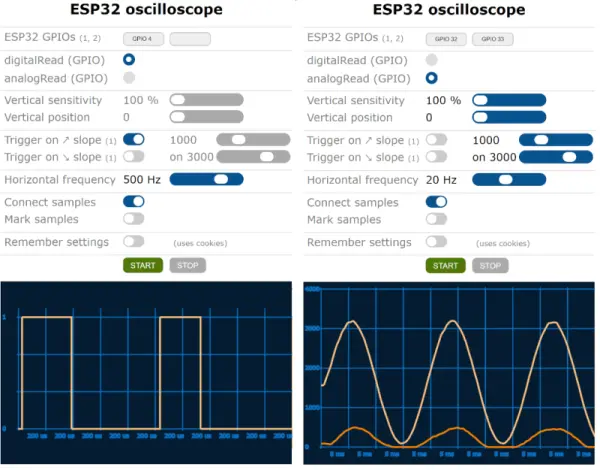
The resulting device manages to keep costs extremely low, but not without a trade-off. For this piece of test equipment, sampling is done over the I2C bus on the ESP32, which can manage a little over 700 samples per second with support for two channels. With the ESP32 connected to a wireless network, the data it captures can be viewed from a browser in lieu of an attached screen, which also keeps the size of the device exceptionally small. While it’s not a speed demon, that’s more than fast enough to capture waveforms from plenty of devices or our own circuit prototypes in a form factor that can fit even the smallest spaces.
Of course for work on devices with faster switching times, it’s always good to keep a benchtop oscilloscope around. But as far as we can tell this one is the least expensive, smallest, and most capable we’ve come across that would work for plenty of troubleshooting or testing scenarios in a pinch. We’ve seen others based on slightly more powerful microcontrollers like this one based on the STM32 and this other built around the Wio Terminal with a SAMD51, both of which also include built-in screens.
Source: ESP32 OSCILLOSCOPE SKIPS SCREEN FOR THE BROWSER
- What sampling rate does the ESP32 scope achieve?
It manages a little over 700 samples per second according to the article. - How many channels does the ESP32 scope support?
The design supports two channels. - How is captured data viewed?
Captured data is viewed from a browser over a Wi-Fi connection instead of an attached screen. - Why is this ESP32 scope considered low cost and compact?
Because it uses an ESP32, samples over I2C, and serves data to a browser, eliminating a built-in screen and bulky components. - Is this scope suitable for high-speed signals?
No, the article notes it is not suitable for devices with faster switching times and recommends keeping a benchtop oscilloscope for those cases. - What kinds of tasks is this ESP32 scope good for?
It is suitable for plenty of troubleshooting or testing scenarios in a pinch and capturing waveforms from many devices and circuit prototypes. - Does the article compare this ESP32 scope to other microcontroller-based scopes?
Yes, it mentions other scopes based on STM32 and Wio Terminal with SAMD51 that include built-in screens.
