
Summary of MACHINE LEARNING ROBOT RUNS ARDUINO UNO
The article describes Nikodem Bartnik’s Arduino Uno–based two-wheeled robot that uses an RPLIDAR to learn autonomous racetrack driving. LIDAR scans and manual control inputs were recorded, features selected, and a machine learning model trained to enable the robot to navigate various cardboard-barrier tracks without a powerful computer.
Parts used in the Machine Learning Robot:
- Arduino Uno
- Slamtec RPLIDAR sensor
- Two-wheeled robot chassis with tank-style steering
- Bluetooth module
- SD card for storage
- Cardboard barriers (racetrack)
When we think about machine learning, our minds often jump to datacenters full of sweating, overheating GPUs. However, lighter-weight hardware can also be used to these ends, as demonstrated by [Nikodem Bartnik] and his latest robot.
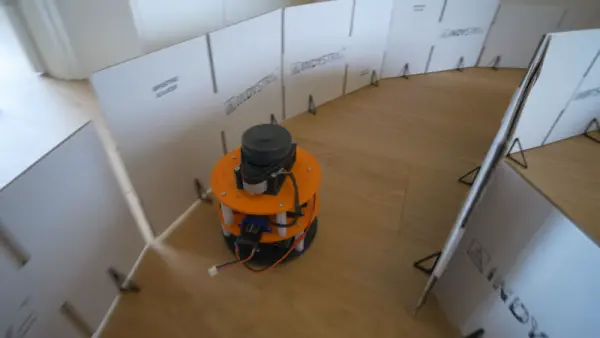
The robot is charged with autonomously navigating a simple racetrack delineated by cardboard barriers. The robot is based on a two-wheeled design with tank-style steering. Controlled by an Arduino Uno, the robot uses a Slamtec RPLIDAR sensor to help map out its surroundings. The microcontroller is also armed with a Bluetooth link and an SD card for storage.
The robot was first driven around the racetrack multiple times under manual control, all the while collecting LIDAR data. This data was combined with control inputs to help create a data set that could be used to train a machine learning model. Feature selection techniques were used to refine down the data points collected to those most relevant to completing the driving task. [Nikodem] explains how the model was created and then refined to drive the robot by itself in a variety of race track designs.
It’s a great primer on machine learning techniques applied to a small embedded platform.
Source: MACHINE LEARNING ROBOT RUNS ARDUINO UNO
- What is the base controller used in the robot?
The robot is controlled by an Arduino Uno. - What sensor is used for mapping surroundings?
The robot uses a Slamtec RPLIDAR sensor. - How was training data collected for the ML model?
Training data was collected by manually driving the robot around the racetrack while recording LIDAR data and control inputs. - Does the robot have wireless connectivity?
Yes, the microcontroller is armed with a Bluetooth link. - Where is recorded data stored?
Recorded data is stored on an SD card. - What steering style does the robot use?
The robot uses a two-wheeled design with tank-style steering. - How were relevant data points chosen for training?
Feature selection techniques were used to refine the collected data to the most relevant points. - Can the trained model drive on different track designs?
Yes, the model was refined to drive the robot by itself in a variety of race track designs.
