
Summary of MEET THE PX-HERO, AN ARM CORTEX-M0+ BASED DEVELOPMENT BOARD FOR EMBEDDED SYSTEMS EDUCATION
Piconomix launched the PX-Hero on Crowd Supply, a low-power STM32L072RB (ARM Cortex-M0+) development board for embedded education, featuring 128 KB flash, 20 KB SRAM, 6 KB EEPROM, 4 Mbit serial flash, microSD slot, 128x64 monochrome LCD, LiPo charger, FTDI USB-serial bridge, multiple I/O and connectors, and power management for battery projects, plus an open-source C library and detailed documentation.
Parts used in the PX-Hero:
- STM32L072RB microcontroller (ARM Cortex-M0+)
- Adesto AT25SF041 4 Mbit serial flash memory
- Spring-loaded push-push microSD card slot
- FTDI FT230XS USB-serial bridge
- Low-power 128 x 64 monochrome graphic LCD with LED backlight
- Li-Po battery charger
- Piezo buzzer
- User LED and battery charger LED
- 6 large user buttons
- Reset button
- Sparkfun Qwiic / STEMMA QT I2C connector
- Seeed Grove I2C connector
- 0.1" header I2C connector
- SPI interface
- TI LM3670 step-down DC-DC regulator
- Zero-burden voltage monitoring circuit
Piconomix, the South-Africa based Embedded systems development company, has launched a campaign on Crowdsupply for a new board called; PX-Hero.
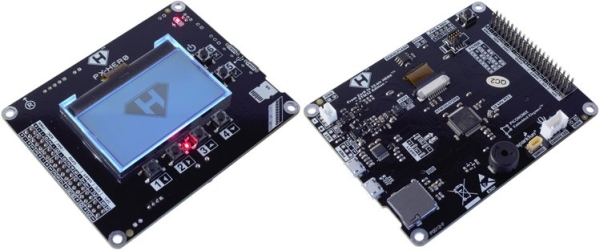
The PX-Her0 is a low-power ARM Cortex MO+ based development board that was developed for use in embedded education applications. The board comes with an ecosystem of tools including an open-source C library, and detailed documentation that is designed to serve as a hands-on guide to help users learn embedded system development at their own pace.
The board is based on the STM32L072RB ultra-low-power, ARM Cortex-M0+ microcontroller with 128kb of FLASH and 4Mbit of serial flash memory using the Adesto AT25SF041 chip, in addition to a spring-loaded microSD card slot which can be used for storage. Showing clear considerations of the need of most beginners, the board comes with a Low-power 128 x 64 monochrome graphic LCD which could be used in teaching how to display data on LCDs, and a LiPo battery charger which makes prototyping battery-based projects easy.
Some specifications and features of the board are provided below:
- Microcontroller: STM32L072RB ultra-low-power ARM Cortex-M0+
- 128k FLASH
- 20k SRAM
- 6k EEPROM
- Memory: Adesto AT25SF041 4 Mbit serial flash memory
- Storage: Spring-loaded push-push MicroSD card slot
- Serial communication: Rock-solid FTDI FT230XS USB-serial bridge
- Rich user interface:
- Low-power 128 x 64 monochrome graphic LCD with LED backlight
- User LED and battery charger LED
- Piezo buzzer
- 6 LARGE finger-friendly user buttons
- Reset button
- Peripheral connectors:
- PWR (+3.6 V to +5 V power bus)
- ADC x 4
- DAC x 1
- GPIO x 8 / PWM x 4
- UART x 2
- I²C x 3 (single I²C bus)
- 1 x Sparkfun Qwiic / STEMMA QT I²C connector
- 1 x Seeed Grove I²C connector
- 1 via 0.1″ header
- SPI x 1
- Power:
- Li-Po battery charger
- A zero-burden voltage monitoring circuit
- Efficient power-path management
- True power on/off circuit
- 95% efficient TI LM3670 step-down DC-DC regulator
- Dimensions:
- Board: 100 x 80 mm (3.94 x 3.15″)
- Display active pixel area: 48.6 x 24.9 mm (1.91 x 0.98″) / 54.6 mm (2.15″) diagonal
Read more: MEET THE PX-HERO, AN ARM CORTEX-M0+ BASED DEVELOPMENT BOARD FOR EMBEDDED SYSTEMS EDUCATION
- What microcontroller does the PX-Hero use?
The PX-Hero uses the STM32L072RB ultra-low-power ARM Cortex-M0+ microcontroller. - How much onboard flash and SRAM does the PX-Hero have?
It has 128 KB of FLASH and 20 KB of SRAM. - Does the PX-Hero include external serial flash memory?
Yes, it includes an Adesto AT25SF041 4 Mbit serial flash memory. - Can the PX-Hero support removable storage?
Yes, it has a spring-loaded push-push microSD card slot for storage. - What display does the PX-Hero provide?
The board provides a low-power 128 x 64 monochrome graphic LCD with LED backlight. - Is there USB-serial connectivity on the PX-Hero?
Yes, it uses an FTDI FT230XS USB-serial bridge. - Does the PX-Hero support battery-powered projects?
Yes, it includes a Li-Po battery charger, efficient power-path management, and a true power on/off circuit. - What power regulator is used on the PX-Hero?
It uses a TI LM3670 step-down DC-DC regulator rated at 95% efficiency. - What user interface components are included?
The board includes a user LED, battery charger LED, a piezo buzzer, 6 large user buttons, and a reset button. - What peripheral connectors are available on the PX-Hero?
Available connectors include multiple ADC, DAC, GPIO/PWM, UART, I2C (including Qwiic/STEMMA QT and Seeed Grove), SPI, and a 0.1" header.
