
Summary of MELEXIS INTRODUCES HIGH-LINEARITY, LOW-DRIFT LINEAR HALL SENSOR FOR SAFETY-CRITICAL AUTOMOTIVE TORQUE-SENSING APPLICATIONS
Melexis introduces the MLX91377, an ASIL-ready linear Hall sensor IC for safety-critical automotive sensing such as EPAS. It offers high linearity, low offset and sensitivity drift, operation up to 160°C, programmable range, multi-point calibration, and multiple output protocols. Developed as a SEooC, it meets ISO 26262 and supports ASIL-C in digital (SENT/SPC) mode and ASIL-B in analog mode. Available in a dual-die TSSOP-16 for redundancy, it targets torque, pedal, position, and level sensing with synchronized SPC triggering, low noise, and high refresh rates for deterministic, fast control-loop performance.
Parts used in the MLX91377 Project:
- MLX91377 linear Hall sensor IC
- TSSOP-16 dual die package (option)
- SENT digital output protocol (supported)
- SPC Short PWM Code protocol (supported)
- Analog output mode (supported)
- Programmable measurement range (feature)
- Multi-point calibration capability (feature)
ASIL-Ready MLX91377 For Steering-Torque And General Automotive Sensing.
Melexis announces the MLX91377 ASIL-ready Hall sensor IC suitable for use in safety-critical automotive systems such as electric power-assisted steering (EPAS).
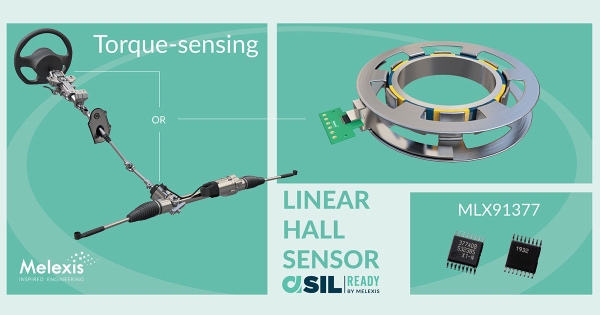
With an ambient operating temperature up to 160°C and combining high linearity with excellent thermal stability, including low offset and sensitivity drift, the MLX91377 supports accurate, dependable torque sensing in EPAS systems to enable safe control in conventional and autonomous driving.
Developed as a Safety Element Out of Context (SEooC), the MLX91377 complies with the ISO 26262 standard and is qualified to AEC Q-100 Grade 0. Supporting functional safety level ASIL-C in digital (SENT or SPC) mode and ASIL-B in analog mode, the MLX91377 offers a high level of functional safety, per die, and can detect internal failures and enter a safe state to prevent unintended vehicle behavior. The available dual die TSSOP-16 package further expands this by offering two fully redundant dies to enable support for safety critical applications like steering and braking systems.
In addition to functional-safety applications, the MLX91377 satisfies a wide variety of automotive and industrial contactless position-sensing use cases including steering torque sensors, acceleration, brake, or clutch pedal sensors, absolute linear position sensors, float-level sensors, non-contacting potentiometers, small-angle position sensors and small stroke position sensors.
The programmable measurement range and multi-point calibration enhance flexibility for designers, and the variety of output protocols enables one IC to be used in multiple applications reducing requalification efforts and costs. The Short PWM Code (SPC) protocol permits measurements to be taken and transmitted upon detection of a trigger pulse. Thus up to four MLX91377 sensors can be synchronized up to 2 kHz, enabling simultaneous magnetic measurements with deterministic latency to ensure high accuracy. In addition, the low-noise and high refresh rate allow high control-loop speeds enabling systems to deliver fast response times with minimal filtering.
- What applications is the MLX91377 suitable for?
According to the article, it is suitable for EPAS steering torque sensing and a variety of automotive and industrial contactless position-sensing uses such as pedal sensors, absolute linear position, float-level, non-contacting potentiometers, small-angle and small stroke position sensors. - What functional safety levels does the MLX91377 support?
The article states it supports ASIL-C in digital (SENT or SPC) mode and ASIL-B in analog mode and is developed as a SEooC complying with ISO 26262. - Can the MLX91377 operate at high temperatures?
Yes, the article specifies an ambient operating temperature up to 160°C. - Does the MLX91377 offer redundancy for safety-critical systems?
Yes, a dual die TSSOP-16 package is available, offering two fully redundant dies for safety-critical applications like steering and braking systems. - How does SPC protocol help with synchronization?
The article explains that SPC permits measurements to be taken and transmitted upon a trigger pulse, allowing up to four MLX91377 sensors to be synchronized up to 2 kHz for simultaneous measurements with deterministic latency. - What performance characteristics aid control-loop speeds?
The article notes low noise and high refresh rate, enabling high control-loop speeds and fast response times with minimal filtering. - Does the MLX91377 provide calibration and configuration flexibility?
Yes, the article indicates it has a programmable measurement range and multi-point calibration to enhance design flexibility. - Can the MLX91377 detect internal failures?
The article states it can detect internal failures and enter a safe state to prevent unintended vehicle behavior.
