
Summary of Arduino MIDI-in shield
This article details the construction of a MIDI-in shield for Arduino, enabling connection to MIDI devices like master keyboards. It outlines the schematic using an optocoupler and resistors for signal decoupling, provides a specific parts list including a DIN connector and pinheads, and offers production tips for etching PCBs and soldering components in Eagle software.
Parts used in the Arduino MIDI-in Shield:
- Resistors (220 Ohms, 100 kOhms, 3.3 kOhms)
- Diode (1N4148)
- Optocoupler (4N28, 4N35, or 4N29)
- 5 PIN DIN connector
- 2 pinheads 1x8
- 1 pinhead 1x4
- 1 pinhead 1x6
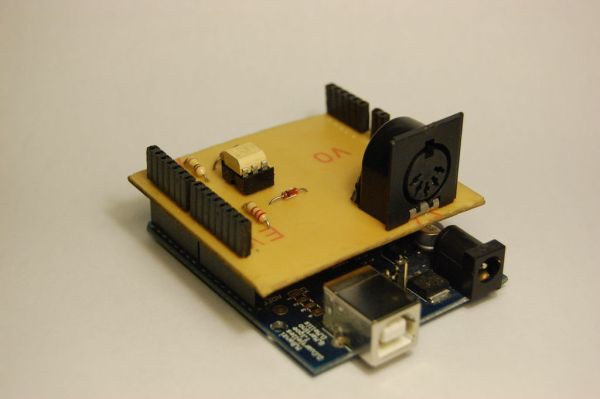
This instructable shows how to build a shield to connect devices that send MIDI signals (e.g. a masterkeyboard) to an Arduino.
The basic schematic is derived from: http://www.arduino.cc/cgi-bin/yabb2/YaBB.pl?num=1187962258/
Step 1: The schematic
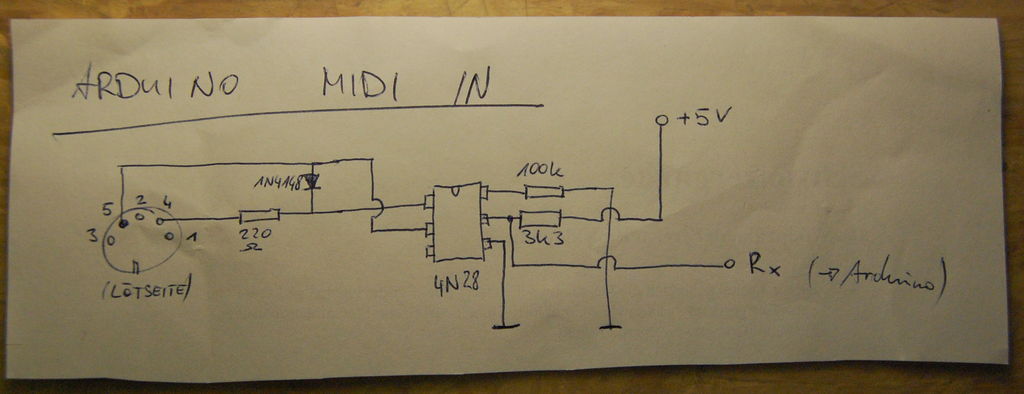
Basically the schematic is just an optocoupler with some resistors to decouple the MIDI device from the Arduino.
Note that the DIN connector on the left side is seen from the back (solder pin-side).
Step 2: Board layout, parts list, etc.
Diode: 1N4148
Optocoupler: 4N28
5 PIN DIN connector (MIDI connector)
2 pinheads 1×8
1 pinhead 1×4
1 pinhead 1×6
 It will also work with other Optocouplers (e.g. a 4N35, I used a 4N29)
Attached are the necessary files for etching the board and the eagle-files if you want to make modifications.
 board.pdf(595×842) 34 KBparts.pdf(595×842) 36 KB
 arduino_shield_MIDI-IN.sch
Step 3: Production
Just a few hints for making the shield:
A very good how-to (that actually worked form me unlike many others) for etching the board can be found here: http://hackaday.com/2008/07/28/how-to-etch-a-single-sided-pcb/
If you are a noob like me and want to modify the board in eagle then try these instructables:
http://www.instructables.com/id/Draw-Electronic-Schematics-with-CadSoft-EAGLE
http://www.instructables.com/id/Turn-your-EAGLE-schematic-into-a-PCB
http://www.instructables.com/id/Make-hobbyist-PCBs-with-professional-CAD-tools-by-
Soldering the pinheads upwards down on the board so you can directly put it on the arduino is a real pain in the ass. I rasped a head of my soldering iron so that it became small enough to do that job. let me know if you have a better solution.
For this board I used a DIN connector that can be soldered directly to it. If you want to use another one be sure to connect the pins with the numbers on the board to the according pins on the connector. In the pic here the pins are seen from the back (where you solder).
Resistors
Diode: 1N4148
Optocoupler
For more detail: Arduino MIDI-in shield
- What is the primary function of this project?
To build a shield that connects devices sending MIDI signals, such as a master keyboard, to an Arduino. - How does the basic schematic work?
The schematic uses an optocoupler with resistors to decouple the MIDI device from the Arduino. - Can I use different optocouplers for this board?
Yes, it will also work with other Optocouplers like the 4N35 or 4N29. - Where can I find files to modify the board design?
Necessary files for etching and modifications are available as eagle-files and PDFs attached to the article. - Is there a recommended guide for etching the board?
A how-to guide found at hackaday.com is suggested for successfully etching single-sided PCBs. - What tools helped the author during soldering?
The author rasped their soldering iron head down to make it small enough for difficult soldering jobs. - How should the DIN connector pins be connected?
You must connect the numbered pins on the connector to the corresponding numbered pins on the board when viewed from the back. - What resources are provided for learning EAGLE?
Links to instructables are provided for drawing schematics and turning them into PCBs using CadSoft EAGLE.
