
Summary of THE FILAMENTMETER: FOR WHEN YOU ABSOLUTELY WANT TO COUNT EVERY METER USED
This article describes the "Filamentmeter," a 3D-printed device that tracks filament usage on Ender 3 printers. It mechanically links to the extruder motor via spur gears, ensuring accurate counting even during retractions. The intricate internal gear system advances digits based on actual filament movement. While designed for the Ender 3, the open design allows for modifications. The creator offers a free test piece to verify compatibility before purchasing the full model.
Parts used in the Filamentmeter:
- 3D printed housing
- Small spur gear
- Series of gears
- Extruder motor (printer component)
[ArduinoNmore] took an interesting approach to designing a counter intended to accurately display how many meters of filament a 3D printer has used. The Filamentmeter looks a little bit like a 3D printed handheld tally counter (or lap counter) but instead of a button to advance each digit, the readout represents how many meters of filament have gone through the extruder.
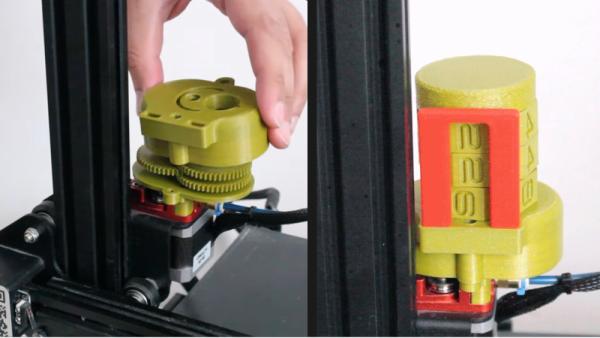
At first glance it may look like there is a motor hidden inside, or that the device is somehow sensing the filament directly. But it’s actually the movement of the extruder motor that drives the device. A small spur gear attached to the printer’s extruder drives a series of gears that advance the digits. This means that retractions — small reverses of the extruder motor during printing — are properly accounted for in the total, which is a nice touch.
[ArduinoNmore] designed this for the Ender 3, and the Filamentmeter relies on a specific extruder design and orientation to work properly. Of course, since it’s 3D printed, modifying the design for your own purposes should be pretty straightforward.
Curious? The design is being sold for a few bucks, and there is a free test piece one can print and use to confirm whether the design will work before mashing the buy button. Non-free printable 3D models can be a world of buyer beware, but test pieces and solid documentation are good ways to give buyers confidence in your work.
The insides of the unit are really quite intricate, with a clockwork-type elegance to them. You can see it all in the short video, embedded below.
Source: THE FILAMENTMETER: FOR WHEN YOU ABSOLUTELY WANT TO COUNT EVERY METER USED
- How does the Filamentmeter count filament?
The device uses a small spur gear attached to the printer's extruder motor to drive a series of gears that advance the digits. - Can the Filamentmeter account for retraction movements?
Yes, because it is driven by the extruder motor, it properly accounts for small reversals during printing. - Which 3D printer is this device primarily designed for?
The design was created specifically for the Ender 3 and relies on its specific extruder design and orientation. - Is there a way to test if the design fits my printer before buying?
A free test piece is available to print and use to confirm whether the design will work for your setup. - Does the device require a hidden motor inside itself?
No, it does not have a hidden motor; it is powered entirely by the movement of the printer's existing extruder motor. - Can the design be modified for other printers?
Since it is 3D printed, modifying the design for other purposes should be straightforward. - Where can I see the intricate internal mechanics of the unit?
The detailed view of the clockwork-type elegance inside the unit is shown in the embedded video.
