
Summary of THE I.MX RT FAMILY MAKES FOR SOME FEATURE FILLED FEATHERS!
This article introduces two new development boards in the Adafruit Feather form factor, powered by NXP's i.MX RT microcontrollers. The first utilizes an RT1062 MCU with a specialized header for WXGA displays and extra GPIOs. The second combines an RT1011 MCU with an ESP32 module acting as a WiFi co-processor on a black PCB. Both boards feature USB-C connectivity, CircuitPython support, and lithium-ion battery charging capabilities while maintaining standard pin compatibility.
Parts used in the New Feather Boards:
- NXP i.MX RT1062 Microcontroller
- NXP i.MX RT1011 Microcontroller
- ESP32 Module
- USB-C Connector
- Lithium-Ion Battery Charging Circuit
- 2.0mm JST Connector
- WXGA Display Interface Header
Thanks to a host of useful feather wings and shields, the Adafruit Feather form factor is becoming a very popular one with a host of other boards now based on it, offering not only the shape and size but also pin compatibility to allow the use feather addons like the FeatherWings and shields. In line with this, Arturo (@Arturo182) recently announced via his twitter handle that he is working on two new Feather form-factor development boards which are based on NXP’s i.MX RT Family of microcontrollers.
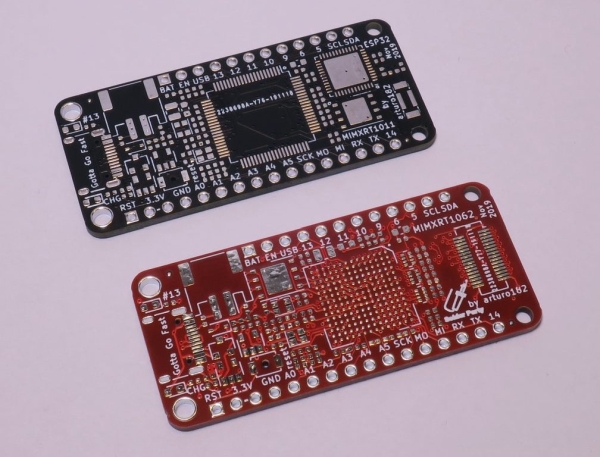
The first board, which is based on the RT1062 MCU is loaded with almost the same functionalities you will find on the Teensy 4.0. It comes with the feather standard arrangement of I/O headers with an extra expansion header that breaks out a suite of pins to allow access to the awesome display interface available on the RT1062. The breakout pin’s to the display interface, which is capable of driving WXGA panels which have a resolution 1366 x 768 pixels and it is also available for use as extra GPIOs when using the board without a display.
The second board is, quite the kicker as it implements not just the RT1011 microcontroller, but also the popular ESP32 module. Coming in a black PCB color, the board trades in extra I/O pins for a hand-solderable QFP package, with the ESP32, complete with all RF components, connected in place of the display extension header on the RT1062 based board. Rather than using the ESP32 in its full glory, which I am sure the component itself would maybe have preferred, it is being used as a WiFi Co-processor, providing WiFi connectivity features to the board while leaving the more powerful RT1011 to focus on running the Circuitpython stack and other burdens laid on it.
Both boards contain pretty tightly packed features but a summary of highlight features, common to both boards, include:
- Adafruit Feather Form-Factor and Pin Compatibility
- NXP i.MX RT series processor on both boards
- USB-C connection (with USB2.0 Specifications) for power and data/programming.
- Both boards support circuit python
- Battery charging for Lithium-Ion cells, via an onboard 2.0mm JST connector
Read more: THE I.MX RT FAMILY MAKES FOR SOME FEATURE FILLED FEATHERS!
- What are the main processors used in these new boards?
The boards use the NXP i.MX RT1062 and i.MX RT1011 microcontrollers. - Can the first board drive high-resolution displays?
Yes, it can drive WXGA panels with a resolution of 1366 x 768 pixels. - How is the ESP32 utilized in the second board?
The ESP32 acts as a WiFi co-processor to provide connectivity while the RT1011 runs the main stack. - Do both boards support CircuitPython?
Yes, both boards support CircuitPython. - What type of connector is used for power and data?
Both boards use a USB-C connection adhering to USB2.0 specifications. - How are lithium-ion cells charged on these boards?
Battery charging occurs via an onboard 2.0mm JST connector. - Does the second board have more or fewer I/O pins than the first?
The second board trades in extra I/O pins to accommodate the ESP32 module. - Are these boards compatible with existing FeatherWings?
Yes, they maintain the Adafruit Feather form-factor and pin compatibility.
