
Summary of 4 Channel RF Remote Controller
This article describes a 4-channel RF remote control system utilizing the PT2262 encoder and PT2272-M4 decoder ICs. The transmitter operates on 5V to 12V DC, while the receiver requires 5V DC. Both units use J1-J8 jumpers for address configuration, allowing 6561 unique combinations to prevent code collisions. When a button is pressed, the encoder transmits data that the receiver validates against its settings before activating one of four TTL-level momentary outputs.
Parts used in the 4 Channel RF Remote:
- PT2262 Encoder IC
- PT2272-M4 Decoder IC
- SW1-SW4 Tact Switches
- Jumper J1-J8
- RF Transmitter Module (ASK RF TX)
- RF Receiver Module (ASK RF RX)
- VT LED
- Relay Board Interface
4 Channel RF remote built using PT2262 and PT2272-M4 IC from Princeton technology. PT2262 used as Encoder (Transmitter) and PT2272-M4 Decoder (Receiver) ICs are heart of the project. The receiver provides 4 channel Momentary outputs. All outputs are TTL level can be interface with other circuits or relay board. Transmitter works with 5V to 12V DC. Receiver works with 5V DC.
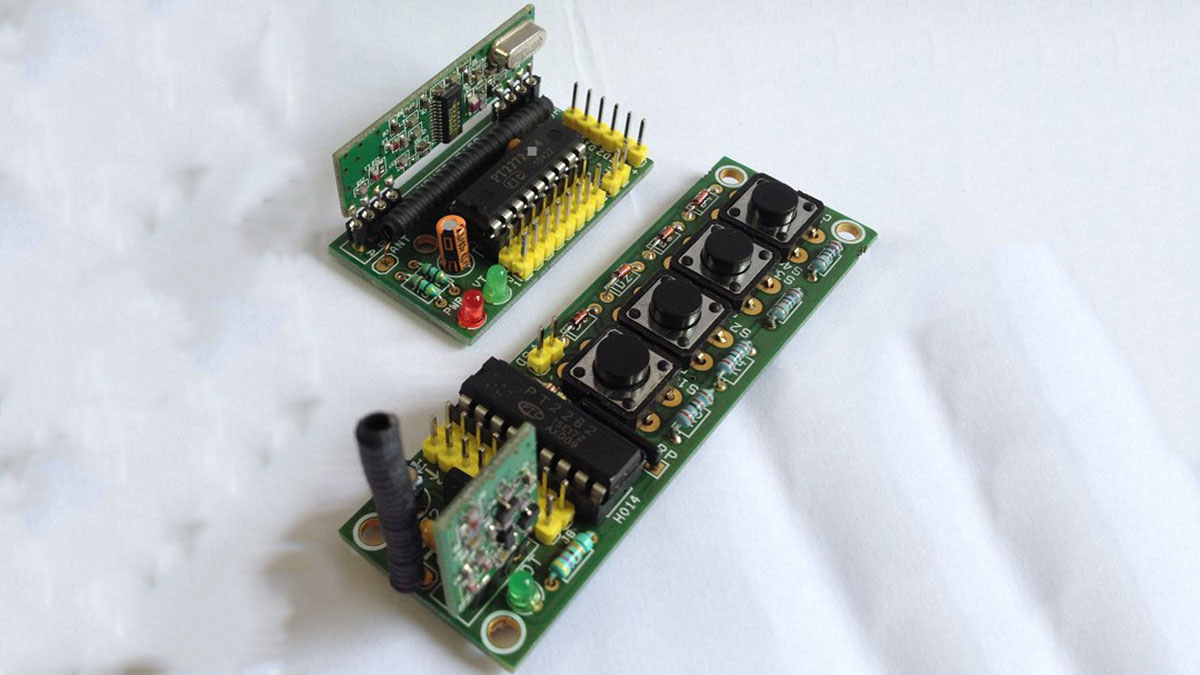
When any of SW1-SW4 (S1-S4) tact switch is pressed the, power is applied to encoder IC and RF transmitter module, the encoder then starts scanning Jumper J1-J8 and transmitting the status of the 8 bits address and data serially. The decoder IC receives the data and compares two times with J1-J8 address jumpers and provides outputs high and also VT LED goes On, if the data is Valid and address of Transmitter and Receiver are same. It is important to have same jumper settings J1-J8 at transmitter and receiver to pair both. Multiple remote can be used to control devices at same location by changing the address codes. All address is Tri-State and offers 6561 combinations.
Encoder – Transmitter (PT2262)
PT2262 is a remote control encoder paired with PT2272 utilizing CMOS technology. Its encode data and address pins into a serial coded waveform suitable for RF modulation. Circuit uses 8 bits of tri-state address pins providing up to 6561 address codes, thereby, drastically reducing any code collision and unauthorized code scanning possibilities.
PT2262 encodes the code address and data set into special waveform and outputs it to the DOUT when TE is pulled to low. The wave is fed to RF modulator (ASK RF TX Module) for transmission. The transmitted radio frequency is received by RF demodulator (ASK RF RX Module) and reshaped to special waveform. PT2272 is then used to decode the waveform and set the corresponding output pins. Thus completing a remote control encoding and decoding function.
Decoder Receiver (PT2272-M4)
PT2272 decodes the waveform received and fed in to the DIN pin. The waveform is decoded into code word that contains the address, data and sync bits. The decoded address bits are compared with the address set at the address input pins. If both address match for 2 consecutive code words, PT2272 drives the data output pins whose corresponding data bits is the decoded to be a 1 bit, and (2) the VT output — to high state.
VT (Valid Transmission)
When PT2272 receive a transmission code word, it initially checks weather this is a valid transmission. For a transmission to be valid, (1) it must be complete code word, and (2) the address bits must match the address setting at the address pins. After two consecutive valid transmission, PT2272 (1) drives the data pins according to the data bits received, and (2) raises VT to high state.
NOTE : Jumper J1 to J8, To set High Jumper provided at Bottom layer of PCB, Jumpers and closure provide to set low, don’t use any of these for floating.
Read more: 4 Channel RF Remote Controller
- How does the transmitter work?
Pressing SW1-SW4 powers the encoder and RF module, which scans jumpers J1-J8 to transmit address and data serially. - Can multiple remotes be used at the same location?
Yes, by changing the address codes via jumper settings to ensure unique identification. - What voltage does the receiver require?
The receiver works with 5V DC power. - How many address combinations are available?
The system offers 6561 combinations using 8 bits of tri-state address pins. - Does the output require special interfacing?
All outputs are TTL level and can interface directly with other circuits or relay boards. - What happens when the VT LED turns on?
The VT LED goes on after two consecutive valid transmissions where the addresses match. - How do you set the jumpers to low?
Closures are provided to set jumpers low; do not leave them floating. - What technology is used for encoding?
CMOS technology is utilized to encode data and address pins into a serial coded waveform.
