
Summary of World’s first light-activated, molecule-sized switch gets turned on
Researchers at the University of Konstanz and HZDR successfully created the world's first light-activated, molecule-sized electrical switch. This three-nanometer device utilizes a diarylethene compound that changes its molecular ring structure from open to closed when exposed to UV light. Embedded gold nanowires facilitate current flow in the closed state, proving that single molecules can function as functional electronic components for future nanotechnology applications.
Parts used in the Molecule-Sized Electrical Switch:
- Diarylethene compound
- Gold nanowires
- UV light beam
In the pursuit of ever-shrinking circuitry for nanotechnology electronics, increasingly smaller devices and components are being developed. Now researchers at the University of Konstanz and the Helmholtz-Zentrum Dresden-Rossendorf (HZDR) in Germany claim to have micro-miniaturized the humble electrical switch all the way down to molecule size and proven its operation for the very first time. Unable to flick such a tiny switch mechanically, however, the researchers instead used light to turn it on.
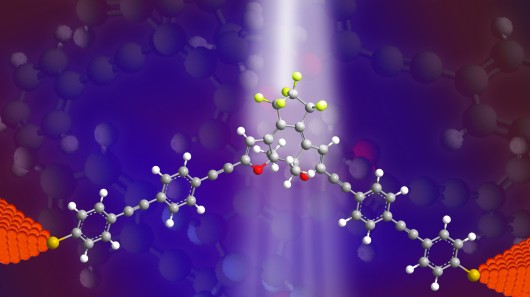
The new three nanometer-wide device is created from a diarylethene compound – a photochromic molecule that reacts chemically when exposed to light. Ring-shaped, a part of the diarylethene molecule ring is open when shielded from light, and then reconnects to the other half on exposure to light. With exceptionally tiny gold nanowires embedded into its structure, this connection then allows an electrical current to flow.
A physicist at the HZDR, Dr Artur Erbe, believes that new components created at a molecular scale will provide opportunities for much smaller and more efficient electronic devices.
“Single molecules are currently the smallest imaginable components capable of being integrated into a processor,” says Dr Erbe.
The researchers claim that the breakthrough capability of being able to switch a molecule on to conduct electrical current has never been fully proven before. This, they say, is because it requires a molecule that ordinarily possesses a strong bond between individual atoms, but is able to dissolve that connection and reform it as required when external energy is applied. Suspended in a fluid in a test tube for the experiments, the molecules were exposed to a beam of UV light to switch them from their open to closed states.
For More Details: World’s first light-activated, molecule-sized switch gets turned on
- What is the size of the new electrical switch?
The device is three nanometers wide. - How do researchers turn on this tiny switch?
They use light, specifically a beam of UV light, to activate it mechanically. - What type of molecule is used to create the switch?
A photochromic diarylethene compound is used for the creation. - Does the molecular ring stay open or close when exposed to light?
The ring reconnects to form a closed state upon exposure to light. - What component allows electrical current to flow in the closed state?
Exceptionally tiny gold nanowires embedded in the structure allow the current to flow. - Why has switching a molecule on not been fully proven before?
It requires a molecule with strong atomic bonds that can dissolve and reform connections using external energy. - Where were the molecules suspended during the experiments?
The molecules were suspended in a fluid inside a test tube. - Who are the researchers behind this breakthrough?
Researchers from the University of Konstanz and the Helmholtz-Zentrum Dresden-Rossendorf (HZDR) in Germany.
