
Summary of WISP – Re-programmable Microcontroller That Runs On Energy Harvested From Radio Waves
This article describes WISP (Wireless Identification and Sensing Platform), a battery-free microcontroller developed by the University of Washington and TU Delft. It harvests energy from ambient radio waves to power itself and receive programmable updates. The system is ten times faster than similar ambient-powered devices and features a 16-bit RISC-derived CPU, sensors, and the Wisent protocol for reliable downstream communication.
Parts used in the WISP project:
- RISC-derived 16-bit microcontroller CPU
- Sensor
- Microchip
- EPC Class 1 Generation 2 RFID tag
- Add-on sensors
- Conventional RFID reader
- Wisent protocol
A new research initiative between the University of Washington’s Sensor Lab and the Technical University of Delft in the Netherlands has created a microprocessor that can power itself through stray radio waves and receive programmable updates in the same fashion. While the RISC-derived 16-bit microcontroller CPU is very weak compared to modern standards, it’s much more powerful than any other device that’s powered by ambient energy in the environment with no battery required.
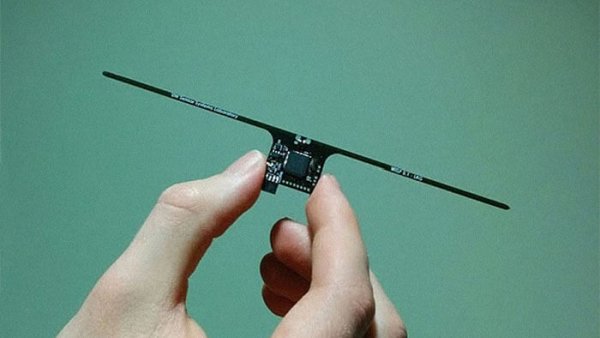
This battery-free system is equipped with a sensor and a microchip, which can be powered entirely by radio waves harvested from the air and is up to 10 times faster than similar ambient-powered devices. Best of all, in contrast to similar devices, it can also download executables, allowing it be reprogrammed or upgraded to newer version of firmware whenever needed. This has significant implications for the Internet of Things development and for ambient computing as a whole.
The variety of handheld, portable technology, and wearable gadgets available today is truly amazing. In order to make devices even more compact and thinner, manufacturers typically try to shrink their designs as much as possible. Unfortunately, device size is ultimately limited by the batteries, all of which have a certain capacity before they dry out and must be recharged again. It is a challenge for engineers and designers to balance battery life with function and aesthetics.
The project of radio wave-driven microcontroller is dubbed WISP, or Wireless Identification and Sensing Platform. RFID (CRFID) technology is an example of WISP. In particular, WISP is capable of being powered passively by converting radio frequencies emitted by conventional RFID (radio frequency identification) readers into electrical power. The project’s latest accomplishment is the addition of Wisent (short for “wirelessly sent”), a faster and more reliable downstream communication-oriented protocol for CRFIDs that can tolerate fluctuations in operating power.
The WISP is constructed out of an open source, open architecture EPC Class 1 Generation 2 RFID tag that incorporates a fully programmable 16-bit microcontroller, in addition to any add-on sensors. It differs from ordinary RFID tags as it is programmable, and can be multi-functional. The team writes in their research paper,
Read more: WISP – Re-programmable Microcontroller That Runs On Energy Harvested From Radio Waves
- What powers the WISP microcontroller?
The device is powered entirely by radio waves harvested from the air. - How fast is the WISP compared to similar devices?
It is up to 10 times faster than other ambient-powered devices. - Can the WISP be reprogrammed after deployment?
Yes, it can download executables to be reprogrammed or upgraded with new firmware. - Does the WISP require a battery?
No, it is a battery-free system that operates without batteries. - What is the Wisent protocol?
It is a faster and more reliable downstream communication-oriented protocol for CRFIDs designed to tolerate power fluctuations. - Which organizations created this research initiative?
The project was created between the University of Washington’s Sensor Lab and the Technical University of Delft. - What type of architecture does the WISP use?
It is constructed out of an open source, open architecture EPC Class 1 Generation 2 RFID tag. - Why do manufacturers try to shrink device designs?
Manufacturers attempt to make devices more compact and thinner to improve their aesthetics and portability.
