
Summary of Wireless notice board using Arduino and GSM
This article introduces a wireless notice board project using Arduino and GSM technology to replace time-consuming manual updates. The system allows users to send text messages from anywhere, which are received by a GSM module, processed by an Arduino via UART, and displayed on an LCD screen. This enables real-time message delivery even when the authorized person is away.
Parts used in the Wireless Notice Board:
- Arduino
- LCD (16*2)
- GSM Module SIM800
- Power supply
- Connecting wires
Everyone would have known the use of notice board around our daily life. Even it plays a vital role in public places like bus stops, railway station and hospitals. But with a great shift in technology we could revolutionize this kind of notice board by taking it wireless. So that’s what this Wireless notice board Arduino project is all about.
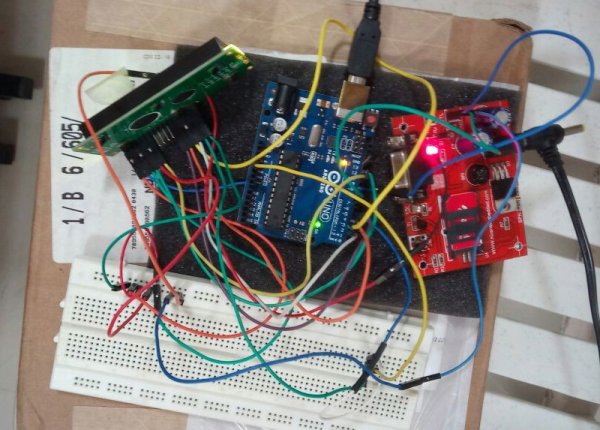
EXISTING SYSTEM:
In the present scenario to display any message on the notice board we type the message in PC and load into pen drive and we dump the information on to the notice board.
But this a time taking and even much complicated process .
If the person is not available then it is more difficult to display the message .so if we interface it with GSM it becomes easy. Even whenever the authorized person is out of station he could convey the information just by sending the message.
COMPONENTS REQUIRED:
- Arduino
- LCD(16*2)
- GSM Module SIM800
- Power supply
- Connecting wires
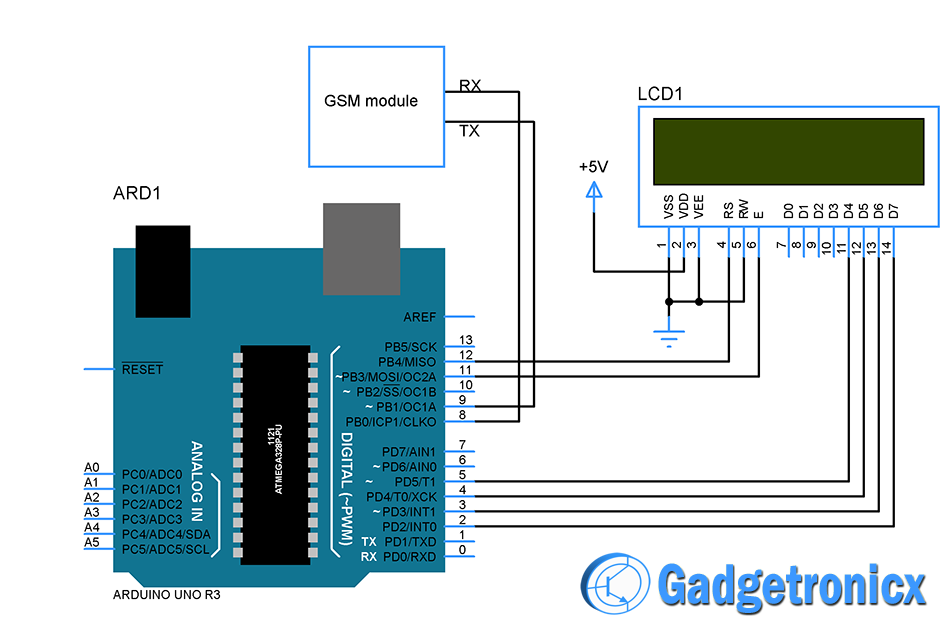
SCHEMATIC DIAGRAM OF WIRELESS NOTICE BOARD:
HOW IT WORKS:
- For this wireless notice board project 16×2 LCD acts as display device
- GSM module acts as a communicating medium
- Normal text message from our mobile will reach the GSM module through the carrier
- Once the message is reached GSM module will send it to the Arduino board through UART communication that is RX and TX
- The code where written in such a way once the message reached it will display it in the LCD.
- GSM technology offers user the facility to send message from anywhere in the world and still it will be display in the notice board
- For the purpose of prototyping have children I have chosen this small LCD module. However you can use any display module compatible with Arduino
Read More: Wireless notice board using Arduino and GSM
-
How does the existing system for displaying messages work?
In the present scenario, you type the message on a PC, load it into a pen drive, and dump the information onto the notice board. -
What role does the GSM module play in this project?
The GSM module acts as the communicating medium that receives normal text messages from a mobile phone through the carrier. -
How is data transferred between the GSM module and the Arduino?
Once the message reaches the GSM module, it sends the data to the Arduino board through UART communication using RX and TX pins. -
What component is used to display the received messages?
A 16×2 LCD acts as the display device where the code ensures the message is shown once it is reached. -
Can the notice board be updated if the authorized person is out of station?
Yes, the authorized person can convey information just by sending a message from anywhere in the world. -
Is the specific 16×2 LCD module mandatory for this project?
No, while a small LCD was chosen for prototyping, any display module compatible with Arduino can be used. -
Why is the traditional method considered complicated?
The traditional method is time-taking and becomes difficult if the person responsible for updating the board is not available.
