
Summary of WELL-ENGINEERED RF AMPLIFIER POWERS HAM RADIO CONTACTS
This article highlights a custom-built 600W broadband RF amplifier designed by amateur radio operator [Razvan] for high-power ham radio contacts. The build utilizes cutting-edge technology, specifically NXP's MRF300 LDMOS transistors arranged in a push-pull configuration. Key engineering features include custom-wound toroids and transformers, a specialized PCB with cutouts for thermal management, and the use of Gallinstan liquid metal alloy instead of traditional silicone grease to ensure efficient heat dissipation from the transistors to a large heatsink.
Parts used in the 600W Broadband RF Amplifier:
- NXP MRF300 power transistors (LDMOS)
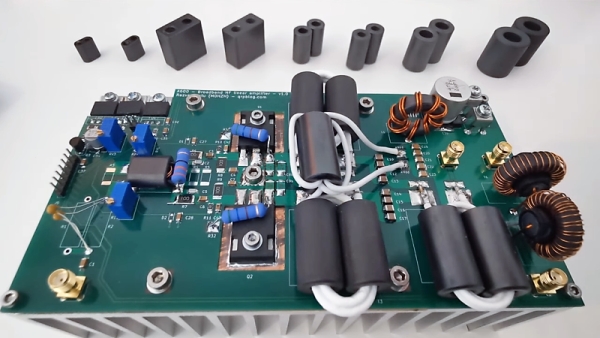
- Custom-wound toroids
- Transformers
- Transmission line transformer wound with 17-ohm coax cable
- Custom PCB with cutouts
- Heatsink
- Gallinstan liquid metal alloy
Typically, amateur radio operators use the minimum power needed to accomplish a contact. That’s just part of being a good spectrum citizen, and well-earned bragging rights go to those who make transcontinental contacts on the power coming from a coin cell. But sometimes quantity has a quality all its own, and getting more power into the ether is what the contact requires. That’s where builds such as this well-engineered 600W broadband RF amplifier come into play.
We’re really impressed with the work that [Razvan] put into this power amp. One of the great joys of being a ham is being able to build your own gear, and to incorporate the latest technology long before the Big Three manufacturers start using it. While LDMOS transistors aren’t exactly new – laterally-diffused MOSFETs have been appearing in RF power applications for decades – the particular parts used for the amp, NXP’s MRF300 power transistors, are pretty new to the market. A pair of the LDMOS devices form the heart of the push-pull amp, as do an array of custom-wound toroids and transformers including a transmission line transformer wound with 17-ohm coax cable. [Razvan] paid a lot of attention to thermal engineering, too, with the LDMOS transistors living in cutouts in the custom PCB so they can mate with a hefty heatsink. Even the heatsink compound is special; rather than the typical silicone grease, he chose a liquid metal alloy called Gallinstan. The video below gives a tour of the amp and shows some tests with impressive results.
Source: WELL-ENGINEERED RF AMPLIFIER POWERS HAM RADIO CONTACTS
-
What is the primary purpose of this amplifier?
The amplifier is designed to provide high power for making long-distance ham radio contacts when minimum power is insufficient. -
Which specific transistors are used in the heart of the amp?
A pair of NXP MRF300 laterally-diffused MOSFETs form the core of the push-pull amplifier. -
How is the transmission line transformer constructed?
The transmission line transformer is wound using 17-ohm coax cable. -
Why was a custom PCB with cutouts utilized?
The custom PCB includes cutouts to allow the LDMOS transistors to mate directly with a hefty heatsink for better thermal engineering. -
What material was chosen for the heatsink compound?
Gallinstan, a liquid metal alloy, was chosen instead of typical silicone grease. -
Are LDMOS transistors considered new technology?
LDMOS transistors have been appearing in RF power applications for decades, though the specific parts used here are new to the market. -
Who built this well-engineered RF amplifier?
The project was built by an amateur radio operator named Razvan.
