
Summary of ULX3S – A POWERFUL, OPEN HARDWARE ECP5 FPGA DEV BOARD
ULX3S is an open-source FPGA development board featuring a Lattice ECP5 chip, designed for both education and complex applications. It supports low-power operations with a battery-backed RTC and offers robust audio/video processing via onboard peripherals like SDRAM, USB, ADC/DAC, and Wi-Fi. The board enables retro computing emulation, motor control, and SDR projects while providing extensive GPIO expansion through PMOD compatibility and easy programming via Arduino IDE.
Parts used in the ULX3S Project:
- Lattice Semiconductor ECP5-series FPGA chip
- Onboard Wi-Fi module
- OLED display
- Buttons and LEDs
- SD card storage interface
- Battery-backed Real-Time Clock (RTC)
- SDRAM memory
- USB peripheral interface
- Digital video output
- FMS/ASK antenna
- Analog-to-Digital Converter (ADC)
- Digital-to-Analog Converter (DAC)
- 56 GPIO pins
- PMOD compatible pinout
ULX3S is a fully open source, compact, robust, and affordable FPGA dev board equipped with a balanced selection of additional components and expansions. Although it was designed primarily as a teaching tool for mastering the principles of digital circuit design, ULX3S incorporates a wide array of features and interfaces that allow it to serve as a broadly useful module for installation in complex devices.
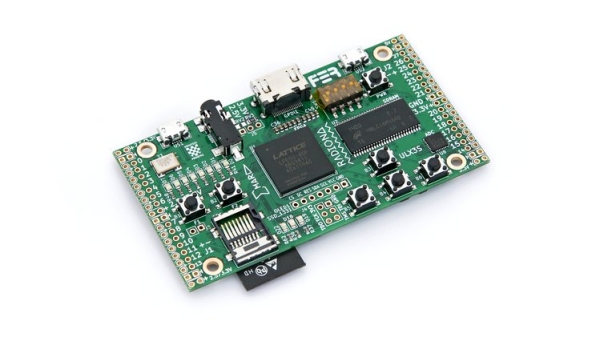
Built around a powerful Lattice Semiconductor ECP5-series FPGA chip and supported by the latest open-source toolchains, ULX3S is one of the most powerful and desirable platforms available for FPGA enthusiasts. It comes equipped with onboard Wi-Fi, display, buttons, LEDs, and storage. Flash it with an over-the-air (OTA) update using the Wi-Fi connection or take advantage of the onboard OLED display and buttons to browse the contents of an SD card and select a bitstream. Due to its battery-backed RTC, ULX3S can power down completely and wake up only in response to certain events. This feature makes it perfect for use in low-power applications such as battery-powered remote sensor nodes.
And if you’re not the low-power type, onboard peripherals like SDRAM, USB, digital video out, onboard FM/ASK antenna, ADC, and DAC make it an audio/video powerhouse for signal processing and synthesis, motor control, and SDR use cases. It can emulate arcade machines and retro computers like the Minimig (Amiga) or modern systems like the F32C (MIPS/RISCV). It has 56 GPIO pins, all routed as differential pairs, and a PMOD compatible pinout, which opens it up to a wide range of expansion options. And if you are just starting out FPGAs, you can use the Arduino IDE to program ULX3S in seconds.
ULX3S has been actively developed since 2016 and is the result of a collaboration between Radiona.org / Zagreb Makerspace and FER – the Faculty of Electrical Engineering and Computing – at the University of Zagreb in Croatia.
Read more: ULX3S – A POWERFUL, OPEN HARDWARE ECP5 FPGA DEV BOARD
- What is the primary purpose of the ULX3S board?
It was designed primarily as a teaching tool for mastering digital circuit design principles. - How can users update the firmware on the ULX3S?
Users can flash it with over-the-air updates using the Wi-Fi connection or browse SD card contents via the OLED display and buttons. - Does the ULX3S support low-power applications?
Yes, its battery-backed RTC allows it to power down completely and wake up only in response to certain events. - Can the ULX3S emulate retro computers?
Yes, it can emulate arcade machines and systems like the Minimig or modern systems like the F32C. - How many GPIO pins does the ULX3S have?
The board has 56 GPIO pins, all routed as differential pairs. - Is the ULX3S compatible with Arduino IDE?
Yes, beginners can use the Arduino IDE to program the ULX3S in seconds. - Which organization collaborated on the ULX3S project?
The project is a collaboration between Radiona.org / Zagreb Makerspace and FER at the University of Zagreb. - What types of signal processing can the ULX3S handle?
Its onboard peripherals make it suitable for signal processing, synthesis, motor control, and SDR use cases.
